News&Knowledge from SgQ
Aluminum Cutting Techniques for Clean Cuts, Edges, and Less Profile Damage
Cutting aluminum smoothly without damaging the profile requires three key factors working together: a suitable TCT saw blade, such as ATB or TCG with 80–120 teeth; securing the workpiece firmly with clamps to reduce vibration; and feeding the blade slowly and steadily at around 1–2 cm per second. Most issues with sharp edges, burrs, and 45° corners not fitting properly can be solved by setting up the machine correctly and choosing the right blade from the start.
✍️ Written by: SGQ Team (SmartGlassQuality Khlong Sam)
📅 Last updated: December 24, 2025
- Why Is Cutting the Foundation of the Entire Aluminum Job?
- Common Problems Caused by Incorrect Cutting
- Proper Tools for Cutting Aluminum Profiles
- Techniques for Smooth, Clean, and Practical Cutting
- 45-Degree Miter Cutting Techniques for Aluminum
- Tips for Cutting Sliding and Swing Door Systems
- Custom Cutting and Assembly Service by SGQ Khlong Sam
- Summary: Professional Aluminum Cutting Techniques
- Frequently Asked Questions (FAQ)
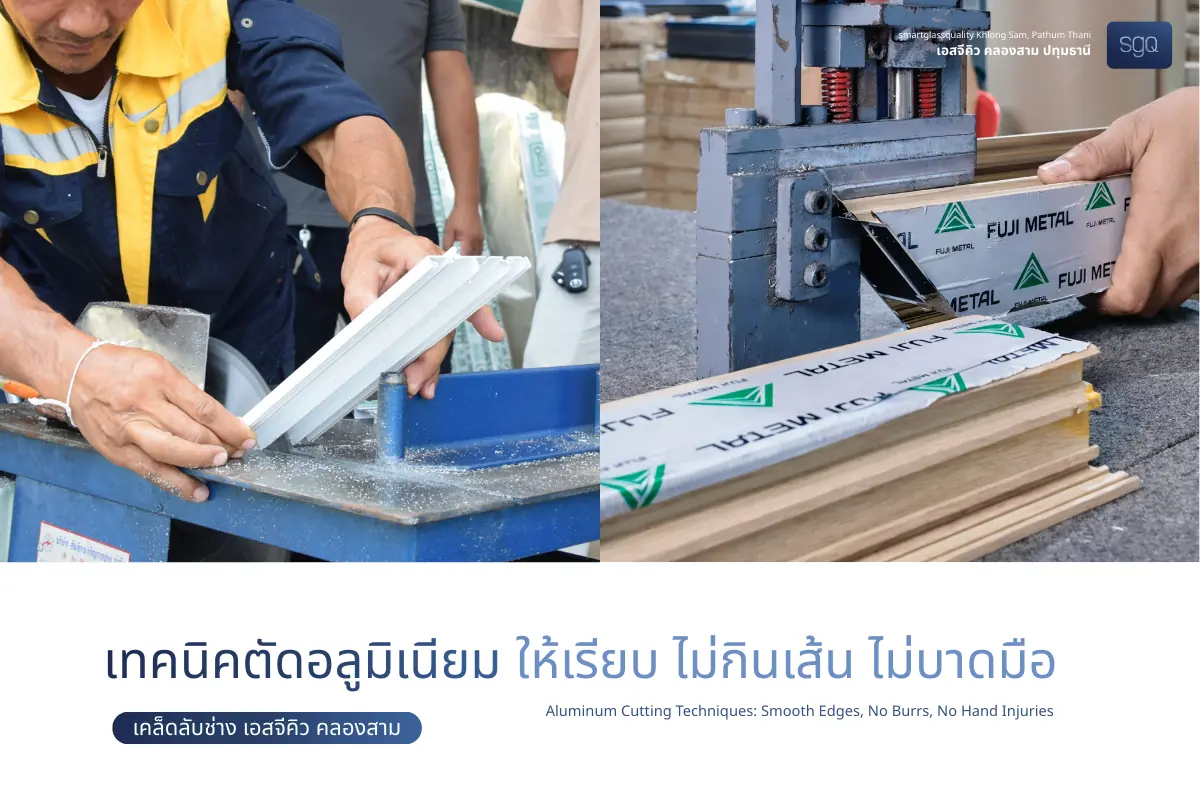
A practical installer’s guide from the SGQ Klong Sam team Whether aluminum work turns out clean or flawed doesn’t depend only on assembly—it starts from “the very first cut.” When the cut is precise, the rest of the job becomes almost half as easy. But a mistake of just 1–2 mm can throw off the entire panel, whether it’s sliding, swing, or awning windows.
This article is intentionally written as a hands-on guide that installers can apply directly on site—covering everything from tools and RPM settings to blade feeding techniques and precise 45-degree miter cuts like factory work. Read it through, and you’ll achieve smooth, clean cuts with no profile damage.
✂️ Need custom aluminum cutting services in Khlong Sam?
SGQ provides accurate cutting, smooth corner joints, and quality checks before delivery. Ready for immediate installation.
📞 081-885-2629 |
💬 Line: @sgqklongsam
Why Is “Aluminum Cutting” the Core of the Entire Work Process?
Aluminum used in door and window systems is a relatively soft metal with multiple built-in grooves—such as drainage channels, rubber seal grooves, T-slots, and hardware fixing tracks. This makes precision cutting especially critical. Using improper tools or feeding the blade too quickly can cause sharp edges, burrs, and poor joint alignment.
The consequences of improper cutting are immediately noticeable, such as:
- Mitered corners do not align properly.
- Sliding panels become stiff or difficult to operate.
- Hardware cannot be fitted into the grooves properly.
- Profile edges are overcut, requiring rework.
In short: “When the first cut is right, the entire job follows.”
What Common Problems Do Technicians Often Face When Aluminum Is Cut Incorrectly?
On real job sites, these issues appear repeatedly and are usually caused by incorrect machine setup or improper blade selection, including:
• Sharp edges / burrs are caused by high heat and blades that are not suitable for soft metals.
• Burnt or blackened cut surfaces are caused by cutting too quickly or not using cutting oil.
• Cuts that are not square can seriously affect assembly because they immediately cause the frame or panel to become misaligned.
• Workpiece vibration during cutting can damage the profile and cause cracks along the edges.
45° corners that do not fit together are caused by incorrect angle settings or a blade that is not centered properly on the arbor.
If these issues are not corrected at the cutting stage, they will always turn into major problems during assembly.
Summary Table of Problems, Causes, and Prevention Methods
What Are the Suitable Tools for Cutting Aluminum?
Achieving clean aluminum cuts without profile damage starts with using the right tools. Experienced installers know well that good blades and good machines result in good work from the very beginning.
เลื่อยองศา (Miter Saw) เหมาะกับงานอลูมิเนียมอย่างไร?
This is the primary machine for aluminum work, delivering the cleanest and most precise 45-degree miter cuts.
- Accurate angle adjustment
- Stable work table
- Secure workpiece locking
- Noticeably cleaner and more precise assembly results
Table Circular Saw / Specialized Aluminum Cutting Saw
Ideal for tasks that require repeated cutting and high precision, such as door and window frame fabrication.
What Type of TCT Saw Blade Should You Choose for Cutting Aluminum?
This is the true core of achieving smooth, clean cuts. The SGQ team recommends the following tooth profiles:
- ATB (Alternate Top Bevel) — optimized for smooth cutting results.
- TCG (Triple Chip Grind) — highly durable and suitable for heavy workloads.
Recommended number of teeth:
- 10-inch blade → 100–120 teeth
- 8-inch blade → 80–100 teeth
What Accessories Help Make Aluminum Cutting Smoother?
- Coolant / cutting oil is useful when cutting large quantities or thick profiles.
It helps reduce heat, minimize burrs, and prevent the saw blade from clogging with aluminum chips. - Deburring tools, fine files, and 240–400 grit sandpaper help make the edges smooth and safe.
- Workpiece clamps reduce vibration, helping cut down profile damage by more than half.
✂️ Don’t want to cut it yourself? SGQ Khlong Sam offers custom cutting and assembly based on your design, ready for installation.
Accurate cutting, smooth corners, and quality checks on every piece before delivery.
Supports every door and window system: sliding, swing, Euro Series, and Pattana Series.
Practical Techniques for Smooth Aluminum Cutting Without Damaging the Profile
This section contains real, daily-used techniques from the SGQ workshop that installers can apply immediately on site.
Why Should the Cutting Point Be Clearly Marked Before Lowering the Blade?
Proper marking is a simple step that can eliminate most cutting errors. Use a carpenter’s pencil, marker, or visible masking tape to ensure a single, precise cut—no rework needed.
How Does Securing the Workpiece Help Reduce Profile Damage During Cutting?
Most aluminum cutting mistakes are caused by vibration.
Using front and rear clamps stabilizes the workpiece, preventing profile damage and producing noticeably cleaner edges.
How Should You Adjust the Machine Speed and Blade Feed Rate?
Many believe that running the saw at maximum speed is best, but in reality, the speed must match the task. For example:
- Thin-wall profiles → high RPM with slow blade feed
- Thick-wall profiles → medium RPM with cutting oil
- For continuous high-volume cutting, use medium RPM to extend blade life.
Golden rule: “Blade speed must be high enough, but feed by hand slowly and consistently.”
How to Cut Aluminum Without Burrs and Finish the Edges Smoothly
- Feed the blade slowly, steadily, and without jerking. The ideal speed is around 1–2 cm per second. Feeding too slowly can cause burning, while feeding too quickly can damage the profile. A steady feed gives the best result.
- Use cutting oil when necessary. When cutting many pieces continuously or working with thick profiles, cutting oil helps reduce heat, keeps the blade teeth sharp for longer, and produces a much smoother finish.
- Remove burrs immediately after cutting. Lightly smooth the edge with a fine file or sandpaper, then test it with your fingertip or a sheet of A4 paper.
If it feels rough or catches on the surface, there are still burrs and the edge should be finished again before assembly.
How Should You Check the Angle and Measurements Before Final Assembly?
Especially for 45-degree miter joints and sliding door systems.
- Corners must fit tightly with no visible gaps.
- Measurements must be consistent on both the top and bottom.
- Hardware must fit smoothly without being forced.
- Grooves must remain straight and aligned.
When cutting is done correctly, the assembly process becomes noticeably easier.
45-Degree Aluminum Corner Joint Techniques Used by Professional Technicians
Miter joints are the point where craftsmanship truly shows. Customers can immediately tell whether the work is refined or not—this is how the SGQ team handles it:
• Set the machine angle every morning. Even a 1–2 mm looseness or shift can make the entire set misaligned.
• Use a TCG tooth blade for corner joint work to achieve a sharp, clean, and smooth cut surface.
• Lock both sides of the workpiece before lowering the blade to reduce vibration by almost 80%.
• Feed the blade steadily so both sides are cut evenly, without damaging or overcutting one side.
Tips for Sliding and Swing Door Systems: How to Cut for Easy Assembly and Smooth Operation
For sliding and swing doors, precision is everything. A cutting error of even 1 mm can lead to stiffness, noise, or difficulty installing hardware.
Installers should always make sure that:
- Cut dimensions are accurate on both the left and right sides.
- Edges are free from burrs.
- 45-degree miter joints fit tightly and cleanly.
- Tracks, rollers, and handles can be installed smoothly without forcing.
Well-cut components can reduce assembly time by up to 30–50%.
SGQ Khlong Sam offers custom aluminum cutting services in Khlong Sam for technicians who need fast, standard-quality work.
For installers looking to reduce preparation time, SGQ provides precision cutting and pre-assembly services with consistent quality standards.
- Accurate, precise cutting to exact dimensions.
- Clean, precise miter joints with no profile damage.
- Every piece is quality-checked before delivery.
Ideal for:
- Installers who need faster job completion.
- Contractors who want consistent quality across every piece.
- Homeowners seeking factory-grade, high-standard workmanship.
All-in-one service—aluminum profiles, glass, hardware, and cutting–assembly services in one place.
If installers or contractors want faster, cleaner, and smoother on-site work but don’t have time to prepare aluminum profiles themselves, SGQ Klong Sam offers custom aluminum cutting and pre-assembly services—ready for immediate installation.
Our in-house team understands all door and window systems, including sliding doors, swing doors, awning windows, frameless glass systems, Euro Profile systems, and Develop Sets.
SGQ Klong Sam is ready to provide professional guidance—from selecting the right door and window systems and aluminum profiles to matching accessories—so your installation is clean, refined, and structurally strong, all completed in one place.
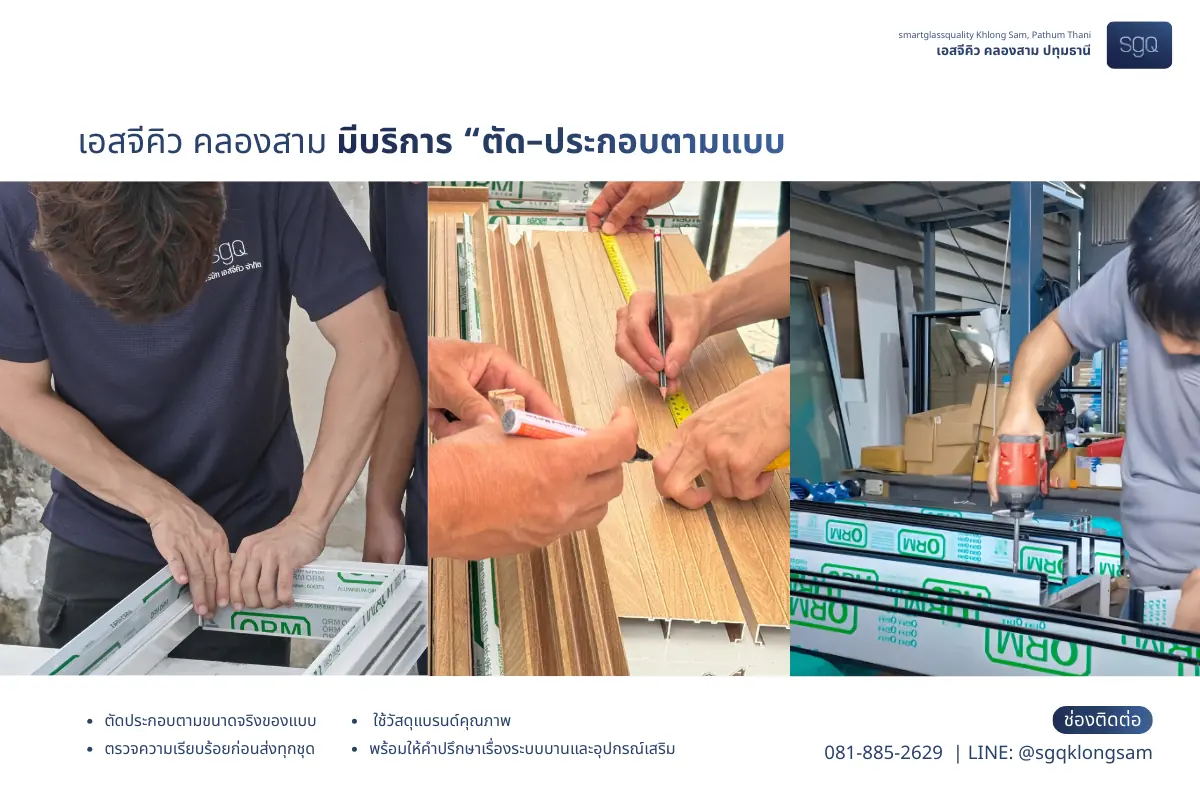
Clean finishes, smooth lines, every profile perfected—because SGQ truly understands real-world installation work.
If you need aluminum cutting and pre-assembly services based on your drawings, or professional advice on selecting the right materials for your job site, visit SGQ Klong Sam, Pathum Thani (Smart Glass Quality). We provide complete aluminum door and window systems—materials and services in one place—while sharing practical knowledge to help every installer improve their craftsmanship.
📖 Related Articles
Starting a Career as an Aluminum Installation Technician: What Do You Need to Prepare?
From Cutting Techniques to Real Installation: A Guide for New Technicians
How Are Euro Aluminum Profiles Different from Pattana Series Profiles?
Understand the Profiles Before Cutting: Choose the Right Type for the Job and Cut More Accurately
Professional Standards for Aluminum Door and Window Installation: What Do Skilled Technicians Follow?
From Quality Cutting to Standard Installation for a Clean Finish Without Rework
Aluminum Door Parts and Hardware: What Should Technicians Know?
After cutting, proper assembly also requires choosing the right parts.
Summary of Professional Aluminum Cutting Techniques by SGQ Khlong Sam Technicians
- A good first cut leads to a better overall result — even a 1–2 mm cutting error can immediately cause the entire panel or frame to become misaligned.
- TCT saw blades — ATB for smooth cutting / TCG for corner joint work, with 80–120 teeth depending on blade size.
- Always secure the workpiece — clamp the front and back to reduce vibration and cut down profile damage by almost half.
- Feed the blade at 1–2 cm per second — too slow can cause burning, too fast can damage the profile, while a steady feed gives the best result.
- 45° corner joint work — check the angle every morning, secure both sides, feed steadily, and remove burrs immediately after cutting.
- Don’t want to cut it yourself? — SGQ offers custom cutting and assembly services based on your design, ready for installation. Call 081-885-2629.
Frequently Asked Questions: Aluminum Cutting Techniques
1. How do you cut aluminum without burrs?
Use a TCT saw blade suitable for aluminum, feed the blade slowly and steadily at around 1–2 cm per second, secure the workpiece with clamps to reduce vibration, and use cutting oil when cutting large quantities or thick profiles. After cutting, remove burrs immediately with a fine file or 240–400 grit sandpaper.
2. What Type of TCT Saw Blade Should You Choose for Cutting Aluminum?
For general work that requires a smooth finish, choose an ATB (Alternate Top Bevel) blade. For corner joint work that requires sharpness and precision, choose a TCG (Triple Chip Grind) blade. The recommended tooth count is 80–100 teeth for an 8-inch blade and 100–120 teeth for a 10-inch blade.
3. How do you make 45-degree aluminum corner joints fit tightly?
Set the machine angle and check it every morning before starting work. Even a 1–2 mm deviation can make the entire set misaligned. Secure both sides of the workpiece with clamps before lowering the blade, use a TCG blade, and feed the blade steadily so both sides are cut evenly.
4. How should you adjust the speed of an aluminum cutting machine?
For thin-wall profiles, use a high speed and feed the blade slowly. For thick-wall profiles, use a medium speed together with cutting oil. For continuous high-volume cutting, use a medium speed to extend blade life. The key rule is: “the blade speed must be high enough, while the feed hand must be slow and steady.”
5. Does SGQ offer custom aluminum cutting services?
SGQ Khlong Sam offers custom cutting and assembly services based on your design, with accurate cutting, smooth corner joints, and quality checks on every piece before delivery. The service supports all door and window systems, including sliding systems, swing systems, Euro profiles, and Pattana series. Contact 081-885-2629 or LINE: @sgqklongsam.
About the Author
This article was written by the SGQ Khlong Sam technician team. A supplier of aluminum profiles with custom cutting and assembly services. Based on real experience in cutting and assembling aluminum doors and windows across many projects.
✂️ Get a smooth, clean finish on every profile with SGQ Khlong Sam’s cutting and assembly services.
Accurate cutting | Smooth corner joints | Quality checks on every piece before delivery
Supports every system: sliding doors, swing doors, Euro profiles, and Pattana series.
Smooth corner joints
📍 19/60-61 Moo 7, Khlong Sam, Pathum Thani | Open Monday–Saturday, 08:00–17:30
For Aluminium Contractors & Installers
If you need aluminium profiles, quality glass, premium hardware, custom cutting & fabrication, installation tools, or on-site technical advice,
you can contact us at:
• Line : https://lin.ee/Wkn1Ong
• Tel : 081-885-2629
• Facebook : Smartglassquality
For Homeowners & Project Owners
If you are looking for aluminium door–window installation, glass works, sliding and swing systems, room partitions, or high-quality materials for home renovation
you can contact us at:
• Line : https://lin.ee/Wkn1Ong
• Tel : 099-392-1963 , 097-936-1449