News&Knowledge from SgQ
Anodized Aluminum Colors: Repair Limitations, Film Thickness, and UV Resistance Every Installer Should Know
Anodized aluminum finishes are very difficult to repair on-site because the film is created by electrochemically transforming the aluminum surface in an anodizing bath, not by applying a paint layer on top. If touch-up paint is used, differences in gloss and color shade will be clearly visible. However, anodizing offers a major advantage in terms of very high UV durability, and its 10–25 micron film, which is integrated into the metal surface, will not fade even after several decades.
✍️ Written by: SGQ Team (SmartGlassQuality Khlong Sam)
📅 Last updated: 20 March 2026
- Why is anodized aluminum so difficult to repair on-site?
- Anodize vs. Powder Coating: Film Thickness and UV Resistance Comparison
- Analytical Comparison Table
- SGQ Recommends: Choose the Right Finish for the Installation Location
- Summary: What Installers and Architects Need to Know
- Frequently Asked Questions
- Understand the limitations to choose the right aluminum finish.
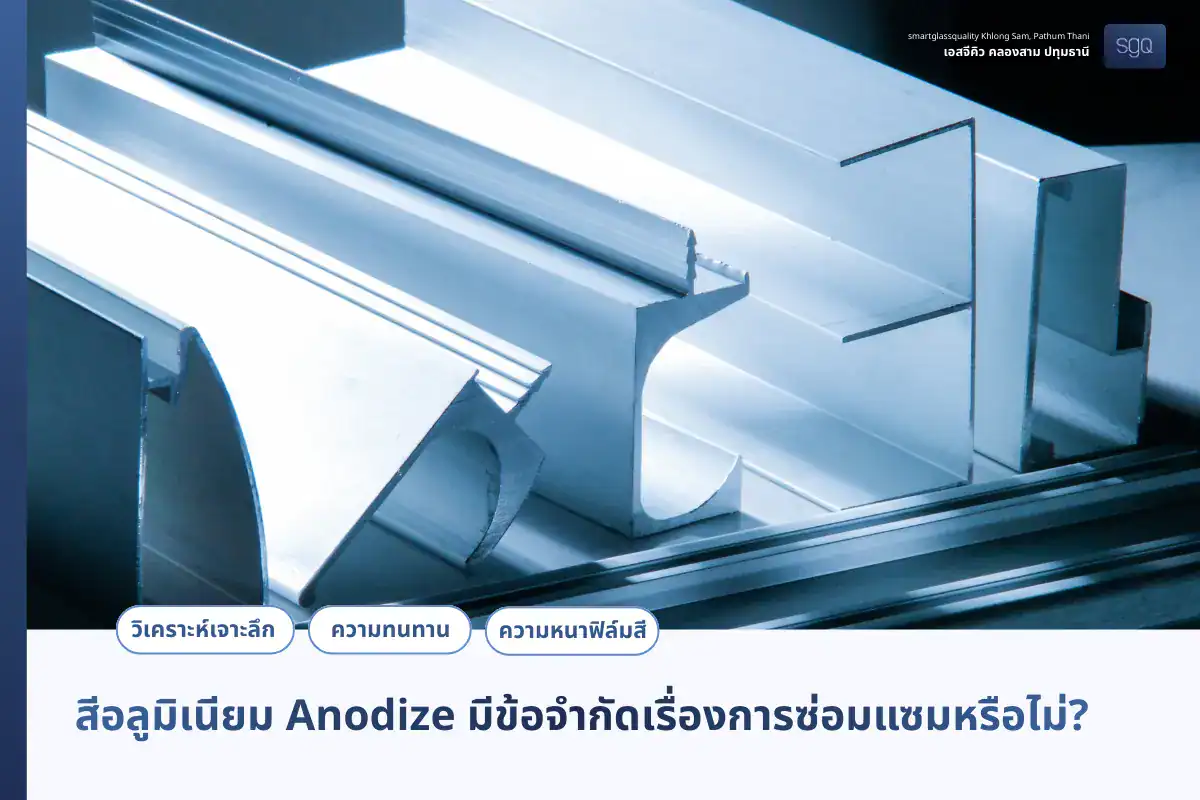
For aluminum installers and architects working on door and window installation projects, choosing between Anodize and Powder Coating is not just about appearance. It directly affects maintenance and repair costs throughout the product’s service life, especially when scratches occur during transportation or installation.
A common question the SGQ Khlong Sam installation team often receives is: “If I buy anodized aluminum profiles and they get scratched during installation, how can they be repaired?” The answer is not as simple as with Powder Coating, which can be touched up immediately, because the anodizing process is fundamentally different in terms of materials engineering.
This article provides an in-depth analysis of the technical limitations of anodizing, compares film thickness and UV resistance with Powder Coating, and includes recommendations from the SGQ Khlong Sam installation team.
Why is anodized aluminum so difficult to repair on-site?
Anodizing is not a surface paint layer. It is an electrochemical process that transforms the aluminum surface in an acid bath. The resulting aluminum oxide film is embedded halfway into the metal and extends halfway outward, which is why it cannot be “stripped off” or “painted over” to look exactly the same as before.
How is the anodizing process different from conventional coating?
Powder Coating is the process of spraying a powder coating onto the aluminum surface and then curing it so it adheres firmly, creating a separate “layer” from the metal itself. If damage occurs, it can be repaired by recoating, and the new finish can blend with the original surface. In contrast, anodizing changes the structure of the aluminum itself. Applying paint over it results in visible differences in gloss and light reflection compared with the original surface.
Why does touch-up repair on anodized surfaces always remain visible on site?
There are three main reasons: color batch variation, where even the same anodizing bath may produce slight differences in shade; the metallic grain pattern of anodized finishes, which gets covered by touch-up paint and immediately appears patchy; and the difference in gloss level between the precisely controlled factory finish and on-site spray repair.
Technical Comparison of Anodize vs Powder Coating: Film Thickness and UV Resistance
Before deciding on an aluminum finish, it is important to understand two key factors: coating film thickness and UV resistance, because both directly affect service life and long-term maintenance costs.
How does the film thickness of anodized aluminum differ from powder coating?
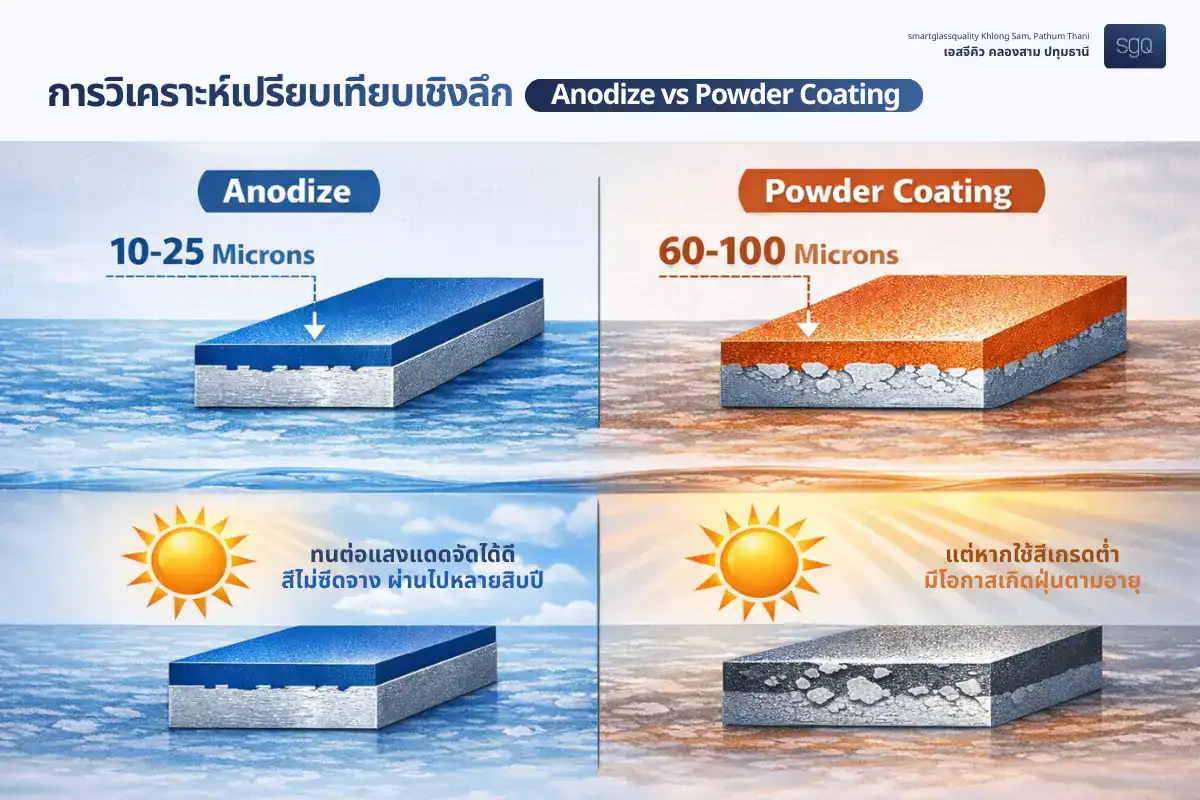
Anodizing has a film thickness of 10–25 microns embedded into the metal surface, so it does not have the problem of peeling off in sheets. It is suitable for applications that require the true feel of metal. In contrast, Powder Coating has a thickness of 60–100 microns, acting as a protective “shield” around the aluminum. It conceals surface imperfections better and is much easier to repair on-site.
Which aluminum finish offers better long-term UV resistance?
Anodizing offers excellent UV resistance because the color comes from the metal’s crystalline structure and chemical dyeing within the oxide layer, not from organic pigments that can degrade over time. As a result, it does not fade or become chalky even after several decades. Premium-grade Powder Coating is also highly durable, but general-grade powder coating may develop chalking after prolonged UV exposure.
Analytical Comparison Table (Technical Table)
| Analysis Topic | Anodized Finish | Powder-Coated Finish |
|---|---|---|
| On-site Repair | Very difficult — differences are clearly visible | Easier — touch-up coating is possible |
| Coating Thickness | 10–25 Microns (integrated into the metal surface) | 60–100 Microns (applied as a surface coating) |
| UV Resistance | Very high — does not fade easily | Depends on the coating grade |
| Surface Feel | Metallic finish with visible aluminum grain lines | Smooth finish with various texture options |
| Ability to Hide Metal Imperfections | Low | High |
| Best Suited For | Exterior applications exposed to strong sunlight | Luxury design projects with easier maintenance |
SGQ Recommends: Choose Anodize or Powder Coating to Suit the Installation Location
The SGQ Khlong Sam installation team stocks aluminum profiles from leading brands and has in-depth knowledge of the properties of each finish type. We are ready to provide analysis based on actual site conditions before you make a production decision, because choosing the wrong finish type can significantly increase long-term maintenance costs.
Which aluminum finish should be used for exterior applications exposed to sunlight all day?
For structures exposed to direct sunlight, such as west-facing windows, high-rise building frames, or open-air balconies, Anodize offers more sustainable beauty over the long term because the color does not fade or become chalky, even after 20–30 years.
Which type of aluminum finish is best for premium design projects that require easy maintenance?
For interior sliding doors, premium residential homes, or projects with a risk of scratches during transportation, Powder Coating—especially Matte Black—is a better choice, because installers can immediately repair minor scratches on site.
SGQ is ready to help you choose the best option.
At SGQ Khlong Sam, we stock standard aluminum profiles from leading brands and have deep expertise in the properties of each finish type:
- Site-based analysis: We help you determine whether Anodize or Powder Coating is the most cost-effective choice for your project.
- Precision cutting and assembly: Because we know anodized finishes are difficult to repair, we use standard machinery for proper design and carry out cutting and assembly with great care to reduce the risk of scratches during the process.
- Quality assurance: You can be confident in the coating film thickness standards from the leading factories whose products we supply.
For consultation or to place an order with SGQ, please call 081-885-2629 or 099-392-1963.
What Installers and Architects Need to Know About Anodized Aluminum Finishes
- Very difficult to repair: The anodized film is part of the metal itself, not a surface paint layer. Any touch-up will show clear differences.
- Thin film at 10–25 microns, but embedded into the aluminum surface, so it does not peel off in sheets.
- Higher UV resistance: Ideal for exterior applications, with color that does not fade even after 20–30 years.
- Powder Coating is easier to repair, with a thickness of 60–100 microns, making it suitable for design-focused projects that require easier maintenance.
- Prevention is better than repair: Always apply protective tape during transportation and installation.
Frequently Asked Questions: Anodized Aluminum Finishes
1. How can scratches on anodized aluminum surfaces be fixed?
If the scratches are only superficial, a fine polishing cream may be used gently to reduce their visibility to some extent. However, if the scratches are deep enough to reach the aluminum itself, any touch-up will show clear differences in gloss and color shade. The best solution is to prevent damage by applying protective tape during transportation and installation, rather than waiting until scratches occur and then attempting repairs.
2. What is the standard film thickness for anodized aluminum finishes?
The standard for architectural applications is 15–25 microns (Class 25), while general applications may use 10–15 microns (Class 15). The thicker the film, the better the corrosion resistance, especially in coastal areas or environments with high pollution. Standard film thickness can help extend service life to more than 20 years.
3. Which is more durable in the long term: Anodize or Powder Coating?
It depends on the application. Anodize offers better long-term resistance to sunlight and UV because the color is part of the metal itself. Premium-grade Powder Coating is also highly durable and easier to repair. For exterior applications exposed to intense sunlight, Anodize is the better choice. But if ease of maintenance is the priority, Powder Coating is more suitable.
4. Why can the color of each Anodize batch vary?
The anodizing process depends on several factors, including the acid concentration in the bath, temperature, processing time, and the composition of each aluminum batch. Visible shade variation may still occur between batches. Therefore, if you want consistent color throughout the project, all materials should be ordered in a single purchase order.
5. Does SGQ provide consultation to help choose the right aluminum finish for a project?
Yes. The SGQ Khlong Sam team is ready to analyze actual site conditions to determine whether Anodize or Powder Coating is more suitable for your installation location, along with recommending aluminum profiles from leading brands that have passed quality selection. Call for a free consultation at 081-885-2629.
Understand the limitations so you can choose the right aluminum finish from the start.
Although anodized aluminum finishes have an important limitation when it comes to on-site repair, they make up for it with the highest level of UV durability and the natural beauty of real metal surface—something no sprayed coating can truly match in the long term.
So the right question is not “Which is better?” but rather “Which is more suitable for your site?” Consulting an expert before placing a production order helps prevent mistakes that are difficult to correct—especially with anodized surfaces, where once scratches occur, it is almost impossible to repair them back to their original appearance.
If you choose the right aluminum finish from the beginning, the next step is proper installation. You can find more details through SGQ Khlong Sam’s door and window installation services. And once installation is complete, do not forget to plan regular maintenance for your sliding doors to maximize their service life and long-term value.
For Aluminium Contractors & Installers
If you need aluminium profiles, quality glass, premium hardware, custom cutting & fabrication, installation tools, or on-site technical advice,
you can contact us at:
• Line : https://lin.ee/Wkn1Ong
• Tel : 081-885-2629
• Facebook : Smartglassquality
For Homeowners & Project Owners
If you are looking for aluminium door–window installation, glass works, sliding and swing systems, room partitions, or high-quality materials for home renovation
you can contact us at:
• Line : https://lin.ee/Wkn1Ong
• Tel : 099-392-1963 , 097-936-1449