News&Knowledge from SgQ
What Every Installer Must Know: Choosing Door and Window Hardware How to Ensure Long-Lasting Durability Without Repeat Repairs
There are 4 main groups of aluminum door and window accessories that must be selected correctly: handles and locking systems, rollers and sliding tracks, hinges, and rubber seals for water and wind protection. Most problems that require technicians to return for repair are not caused by installation, but by choosing accessories that are not suitable for the sash type or glass weight. Choosing Stainless SUS304 grade materials for exterior work and ball-bearing rollers for heavy panels is the key to a job that does not require repeated repairs.
✍️ Written by: SGQ Team (SmartGlassQuality Khlong Sam)
📅 Last updated: January 23, 2026
- 4 Main Hardware Components You Should Choose Correctly from the Start
- Choosing the Right Hardware for Real Job Site Conditions
- Material Deep Dive: Why Hardware Quality Can Vary So Much
- Common Mistakes That Cause Hardware to Wear Out Faster
- Professional Installation Tips for Aluminum Technicians
- Comparison of Popular Hardware Brands Used by Technicians
- How Homeowners Can Check the Quality of Installation Work
- Summary: How to Choose Aluminum Door and Window Hardware
- Frequently Asked Questions (FAQ)
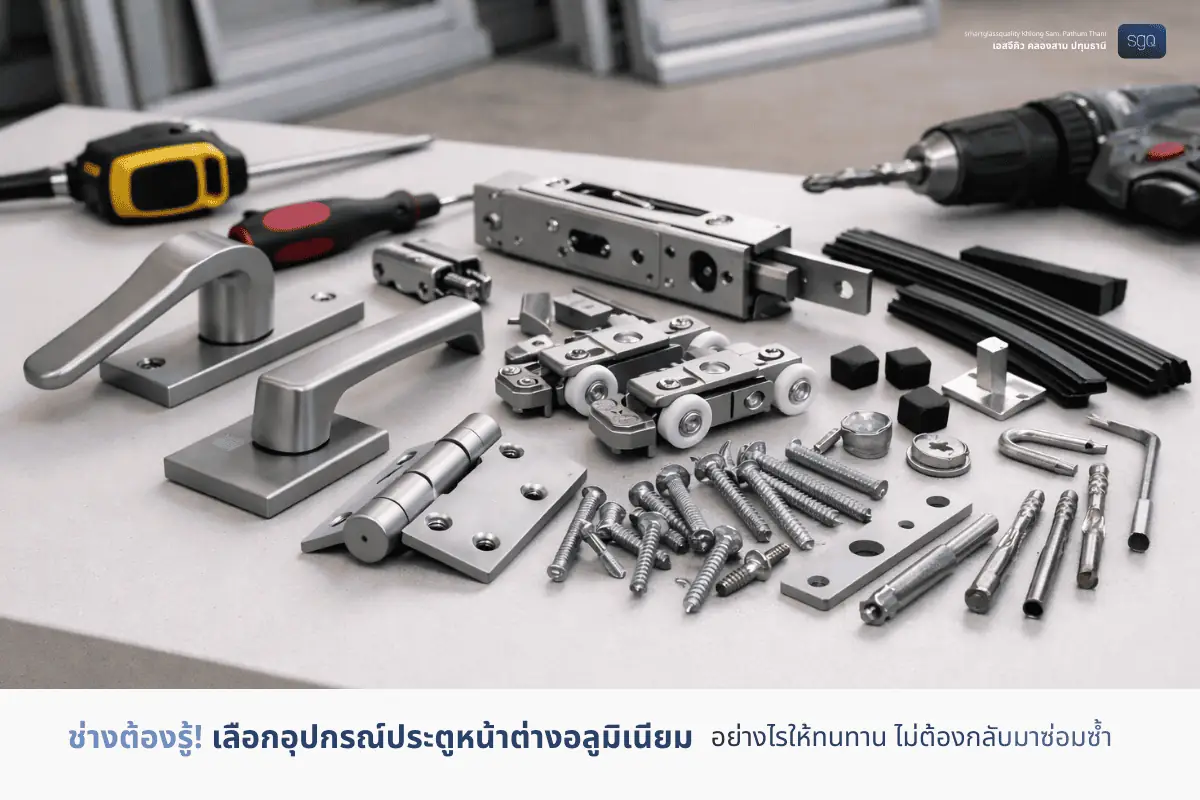
On real job sites, many installers have faced similar situations…
Everything looks perfectly finished at handover—but just a few months later, customers call back with problems such as broken rollers, stiff sliding panels, loose handles, or water leakage along the frame. This leads to repeat repairs, wasted time, extra travel costs, and damage to a professional reputation that shouldn’t have been lost.
In most cases, the problem isn’t installation alone. It often comes from choosing aluminum door and window hardware that doesn’t match the door type, or using components whose material quality fails to meet real-world job standards.
This article breaks it down—installer to installer. We’ll cover which components truly matter, how to choose durable hardware, and which installation methods help eliminate repeat repair jobs.
Helping installers work more efficiently—and protect their professional standards in the long run.
🔩 Need aluminum door and window accessories at technician-friendly prices?
SGQ Khlong Sam offers rollers, hinges, handles, and rubber seals in all grades, with practical advice from technician to technician.
📞 081-885-2629 |
💬 Line: @sgqklongsam
4 Main Aluminum Door and Window Accessories That Must Be Chosen Correctly from the Start
Aluminum door and window systems consist of many components, but when it comes to durability, there are four key groups that truly matter.
1.1 Handle & Lock System
Although these components may seem small, they directly impact security, usability, and the overall stability of the door panel.
Common Types of Handles
- Push Handle – Easy to operate, ideal for standard sliding doors.
- Lever Handle – Provides better pressing force, suitable for hinged and awning windows.
- Multi-point Lock System – Ideal for tall panels or homes that require higher security.
How to Choose for Long-Term Durability
- Choose rust-resistant materials such as stainless steel or high-quality zinc alloy.
- The handle and lock should have sufficient thickness (gauge) to withstand pulling and daily use.
- The locking system should include a solid strike plate securely fixed to the aluminum frame to prevent loosening over time.
1.2 Sliding Door Rollers and Tracks (Roller & Track System)
This is the number one cause of repeat repair calls for installers. Especially for homes with large, heavy panels, thick glass, or doors that are used daily.
Key Factors to Check Before Purchasing
- Twin-wheel rollers provide better load distribution and higher weight capacity than single-wheel types.
- A ball bearing system is essential—it ensures smoother movement and significantly extends service life.
- The roller material should be high-grade nylon, or stainless steel for premium applications.
- For panels weighing over 80–120 kg, heavy-duty load-rated rollers must be used.
1.3 Hinges
A small component that carries the weight of the entire panel. The larger the glass panel, the more critical hinge specifications become—undersized hinges will inevitably cause panel sagging.
Which Type Should You Choose?
- Stainless steel hinges made from SUS304 or SUS316 offer excellent corrosion resistance.
- Adjustable hinges are ideal for projects that require fine alignment and precise finishing.
- Always use the correct number of hinges according to panel size and weight.
- For panels 180–200 cm in height, use at least three hinges or more.
- If using 10 mm thick glass, only heavy-duty load-rated hinges should be selected.
- For panels 180–200 cm in height, use at least three hinges or more.
1.4 EPDM Rubber Seals and Water/Windproof Seals (Weather Strips)
This is a component customers rarely notice—but it plays a critical role in achieving a clean, professional finish.
Low-quality weather strips can lead to multiple long-term problems:
✓ Water leakage during heavy rain
✓ Air leakage and whistling noise
✓ Excessive dust entering the interior
✓ Panel friction against the frame, causing surface scratches
Recommended Materials
- EPDM rubber – Highly resistant to heat and UV, remains flexible and does not harden easily.
- PVC / TPE – More affordable, but offers lower heat resistance compared to EPDM.
Principles for Choosing Aluminum Door and Window Accessories to Suit the Actual Job Site
Every home has different usage conditions…
And this is exactly why the same hardware brand can perform durably in one home, yet fail prematurely in another.
2.1 For Large or Heavy Sliding Panels
-
Use twin ball bearing rollers for better load distribution and smoother operation.
-
The roller body should be made from stainless steel or premium-grade nylon.
-
Select rollers based on load ratings specified in the manufacturer’s guide, such as 80–150 kg per panel.
-
Use high-rigidity aluminum tracks with a thick base; Euro Profile systems are recommended for premium installations.
Caution: Never use standard plastic rollers on large panels—they wear out quickly and will inevitably cause stiff operation and customer complaints.
2.2 For Hinged and Awning Doors/Windows
-
Choose hinges that have passed a salt spray test of 48–96 hours for corrosion resistance.
-
For panels taller than 1.8 meters, use 3–4 hinges to ensure proper load support.
-
During installation, ensure the panel is perfectly aligned—uneven leveling causes unequal load distribution, leading to premature sagging.
A Closer Look at Hardware Materials: Why Quality Varies So Widely
3.1 Stainless Steel
Ideal for hardware components that must support heavy loads and are exposed to outdoor conditions.
-
Recommended grades: SUS304 / SUS316
-
Excellent corrosion resistance with a long service life.
3.2 Zinc Alloy
-
Commonly used for handles and locking components.
-
Provides adequate strength, but should not be used for heavy load-bearing applications.
-
Surface treatment quality is crucial—choose products with proper finishes such as powder coating or anodizing.
3.3 Salt Spray Test
A key indicator of hardware quality, measuring resistance to moisture and salt exposure.
-
The higher the test rating, the better the corrosion resistance.
-
For modern residential projects, a minimum rating of 48 hours or more is recommended.
Common Installer Mistakes That Cause Premature Hardware Failure
These are the most common reasons installers are forced to return and fix the same job repeatedly.
4.1 Improper Leveling During Installation
When the frame is not properly aligned, the rollers carry uneven loads, leading to:
- Broken rollers
- Stiff or difficult panel movement
- Grinding or knocking noises during sliding
4.2 Using Low-Quality Weather Strips
Customers will experience issues such as:
- Water leakage
- Sound leakage
- Whistling noise caused by air penetration
- Dust infiltration
→ This often leads customers to assume “poor workmanship,” even though the real issue is material quality.
4.3 Using Incorrect Screws or Fasteners
Screws that are too short fail to secure components properly, causing handles to loosen within a few months.
Non-stainless screws corrode quickly and lead to premature failure.
Always use screws and fasteners that match the hardware manufacturer’s specifications.
4.4 Installing Rollers and Hinges Without Proper Adjustment
After assembling every panel, it must always be “adjusted and aligned” properly. Some homes have slightly uneven floors. If the panel is not aligned correctly → the panel will definitely sag.
🔩 Need aluminum accessories at technician-friendly prices? SGQ has everything you need.
Twin Ball Bearing Rollers | Stainless Hinges | EPDM Rubber Seals | Handles in All Models
Get specification advice that matches the actual panel, so you do not have to rely on trial and error.
Professional Installation Techniques to Ensure 100% Hardware Durability
5.1 Balance Roller Load Through Proper Adjustment
Adjust the rollers so the panel height is even and remains level without tilting left or right.
5.2 Proper Silicone Sealant Application
- Apply silicone sealant in a continuous, uninterrupted bead.
- Never leave gaps, as they become direct pathways for water leakage.
- Select a grade suitable for aluminum applications, such as Neutral Cure Silicone.
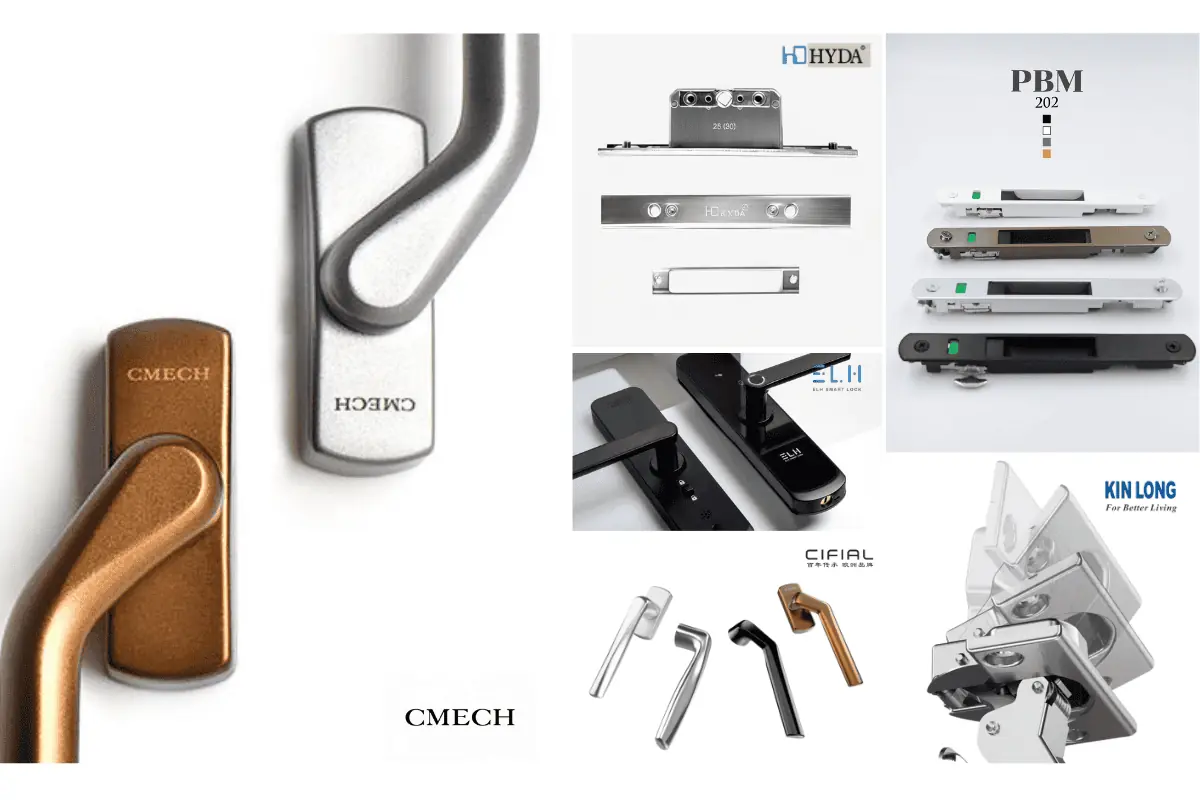
Comparing Aluminum Door and Window Hardware Brands Commonly Used by Installers
Note: This is not a brand promotion, but a comparison based on real on-site installation experience.
Brands Commonly Chosen by Installers for Durability
- CMECH – Premium-grade hardware, ideal for large and heavy panels.
- KINLONG – Widely used in project developments, known for reliable durability.
- PBM / Giesse / Hafele – Stable mechanisms with clean, precise operation.
- Premium-grade Chinese brands – Cost-effective and suitable for general applications.
Pricing Considerations
- For a sliding door set, pricing depends mainly on panel size and hardware brand selection.
- For hinged doors, primary cost factors include hinge specifications and multi-point locking systems.
- Advise customers to choose mid-range or higher-grade hardware if the doors or windows are used daily.
Advice for Homeowners: How to Check Installation Quality
Even homeowners without technical knowledge can perform basic checks to see whether the installation quality is truly up to standard.
- Sliding panels move smoothly without stiffness or vibration.
- Handles are firmly fixed and do not wobble.
- Weather strips are fully installed along the frame with no visible gaps.
- Doors and windows close tightly, with no air leakage or whistling sounds.
- Hardware components feel solid and durable—not thin, brittle, or fragile.
Good Hardware Makes the Job Easier—and Customers Happier
Aluminum door and window hardware is not an area where cutting costs pays off. When hardware is selected to match panel weight, application type, and material quality, installers can work more efficiently, avoid repeat repairs, reduce time-related costs, and protect their professional reputation in the long run.
If installers need advice on selecting hardware that truly matches panel specifications, or require custom bending, cutting, or assembly support, SGQ Khlong Sam is always happy to help.
📖 Related Articles
Solving Noisy Aluminum Door Problems: A Case Study from a Real Job Site
When the Wrong Accessories Are Chosen, These Are the Problems That Follow — Learn from a Real Case
Why Do Professional Technicians Choose to Order Ready-Made Aluminum Products from a Store Instead of Producing Them Themselves?
Cost, quality, and time-saving reasons that make ordering from a shop more worthwhile.
Starting a Career as an Aluminum Installation Technician: What Do You Need to Prepare?
A Guide for New Technicians Who Want to Start in the Right Direction
Summary of How to Choose Aluminum Door and Window Accessories for Long-Lasting Use
- 4 main accessories — handles + locks, rollers + tracks, hinges, and EPDM rubber seals — none of these should be overlooked
- Rollers — use Twin Ball Bearing rollers for heavy panels. Standard plastic rollers wear out very quickly on large panels
- Hinges — use Stainless SUS304 or higher. Panels 180 cm high should use 3 hinges
- Rubber seals — EPDM offers the best heat and UV resistance for exterior applications
- 4 mistakes to avoid — uneven installation, low-quality rubber seals, using the wrong type of screws, and not adjusting the panel after installation
- Get advice from SGQ Khlong Sam — we offer a complete range of accessories at technician-friendly prices, with specification advice based on the actual job site
Frequently Asked Questions: Aluminum Door and Window Accessories
1. Which type of aluminum sliding door roller is the best?
For general panels, use high-grade Nylon rollers with a Ball Bearing system. For large panels or glass thicker than 6 mm, use Stainless Twin Ball Bearing rollers that can support 80–150 kg per panel. Never use standard plastic rollers for large panels.
2. How many Stainless aluminum hinges should be used per panel?
For panels up to 180 cm high, use 2 hinges. For panels 180–200 cm high, use 3 hinges. If the glass is 10 mm thick or more, only heavy-duty hinges should be used. Stainless SUS304 hinges that have passed a Salt Spray Test of 48 hours or more are recommended.
3. What is the difference between EPDM and PVC rubber seals, and which one is better?
EPDM is heat-resistant, UV-resistant, and does not become hard and brittle easily. It is suitable for exterior work exposed to sun and rain. PVC is cheaper, but has lower heat and UV resistance, so it hardens and cracks faster in Thailand’s high-temperature climate. EPDM is recommended for long-term durability.
4. What is a Salt Spray Test, and why is it important for technicians?
A Salt Spray Test is a test used to measure resistance to moisture and salt mist. The longer an accessory passes the test, the better its rust resistance. For homes in Thailand, it is recommended to choose accessories that have passed a Salt Spray Test of at least 48 hours or more.
5. Where can you find aluminum accessories at technician-friendly prices?
SGQ Khlong Sam supplies a complete range of aluminum door and window accessories, including rollers, hinges, handles, EPDM rubber seals, and all types of spare parts at technician-friendly prices. We also provide advice on which specifications are suitable for the actual panels technicians are working with. Contact us at 081-885-2629 or LINE: @sgqklongsam
About the Author
This article was written by the SGQ Khlong Sam team A complete supplier of aluminum door and window accessories, including rollers, hinges, handles, and rubber seals Based on real experience working with technicians and contractors across many projects in Pathum Thani and Bangkok
🔩 Need aluminum door and window accessories? SGQ has everything you need at technician-friendly prices
Twin Ball Bearing Rollers | Stainless Hinges | EPDM Rubber Seals | Handles in All Models
Get specification advice based on the actual job site, so you do not have to rely on trial and error.
📍 19/60-61 Moo 7, Khlong Sam, Pathum Thani | Open Monday–Saturday, 08:00–17:30
For Aluminium Contractors & Installers
If you need aluminium profiles, quality glass, premium hardware, custom cutting & fabrication, installation tools, or on-site technical advice,
you can contact us at:
• Line : https://lin.ee/Wkn1Ong
• Tel : 081-885-2629
• Facebook : Smartglassquality
For Homeowners & Project Owners
If you are looking for aluminium door–window installation, glass works, sliding and swing systems, room partitions, or high-quality materials for home renovation
you can contact us at:
• Line : https://lin.ee/Wkn1Ong
• Tel : 099-392-1963 , 097-936-1449