News&Knowledge from SgQ
Aluminum Door & Window Installation Techniques for Meeting Project-Grade Standards | SGQ Klong Sam
Installing aluminum doors and windows to meet project standards requires 5 main steps: inspecting the site and opening dimensions, aligning the frame vertically using a spirit level, installing the sash so the track is not tilted, sealing with exterior-grade silicone, and testing each sash by opening and closing it 10 times before handover. A good project installation must pass vertical alignment checks, opening and closing system checks, and leakage testing by QC before handover.
✍️ Written by: SGQ Team (SmartGlassQuality Khlong Sam)
📅 Last updated: December 11, 2025
- Why Does Project Work Require Higher Standards?
- Differences Between Residential Work and Project-Grade Work
- Tools to Prepare Before Entering a Project Site
- 5-Step Checklist for Standard Aluminum Installation
- Common On-Site Problems and How to Fix Them
- How to Choose Materials and Hardware for Project Work
- Final Inspection Checklist Before Handover
- SGQ Tips for Project-Grade Aluminum Work
- Summary: How to Install Aluminum to Project Standards
- Frequently Asked Questions (FAQ)
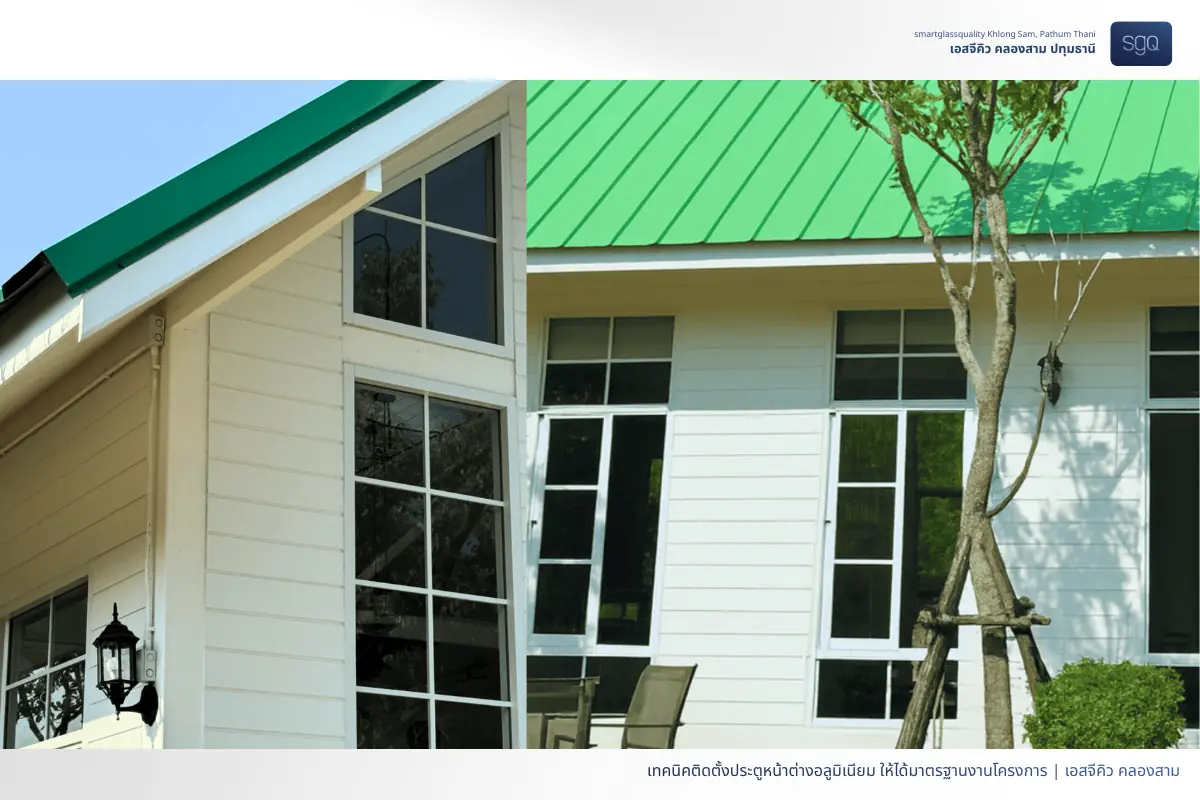
In construction projects—whether condominiums, housing estates, or office buildings—aluminum door and window systems are critical components that must meet standards of strength, aesthetics, and safety, as they are among the first elements noticed by project owners and end users.
However, in actual field installation, there are many small details that, if overlooked, can turn into major issues—such as stiff sliding panels, water leakage, or misaligned frames that fail to close properly.
Today, SGQ Klong Sam would like to share professional techniques for installing aluminum doors and windows to meet project-grade standards, based on real on-site experience—helping contractors deliver work that is clean, strong, and inspection-ready.
🏗️ Looking for aluminum materials and accessories for project-based work?
SGQ Khlong Sam has every specification you need, with recommendations on materials and accessories based on actual site requirements.
📞 081-885-2629 |
💬 Line: @sgqklongsam
Why must aluminum installation work in projects meet higher standards than general residential work?
For normal house installations, installers may focus mainly on appearance and functionality. However, project-level work requires stricter standards—covering structural integrity, safety, and long-term weather resistance.
If the installation does not meet specifications—such as insufficient aluminum thickness or frames that are not properly aligned—it may be rejected during project inspection.
Examples of Common Specifications Used in Project Installations
- Use Euro Profile aluminum systems or Develop Sets according to the project specifications. Euro Profile systems are ideal for high-rise buildings or projects that require superior strength and sound insulation, while Develop Sets are suitable for housing estates or renovation work where good quality at an accessible price is needed.
- Minimum aluminum thickness: 1.2–1.6 mm
- Use 5–8 mm tempered glass or laminated glass
- Must pass water leakage and vertical alignment inspection (tolerance not exceeding ±2 mm)
However, some values may vary depending on the project specification. This is why project work is not just about “completing the installation,” but “meeting the required standards” in every detail.
What is the difference between general residential work and large-scale project work?
Home installations often prioritize design and aesthetics, while project work focuses first on accuracy and long-term durability.
Contractors handling project work must fully understand shop drawings, specifications, and inspection procedures.
Therefore, anyone preparing to take on project-based work should first understand these differences, so they can properly prepare their team, tools, and materials.
Tools and equipment technicians should prepare before starting project-based work
Aluminum installation in project work typically involves large volumes and complex site conditions. Preparing the right tools helps significantly reduce errors.
Below are the items SGQ’s installation team commonly recommends:
- Water Level or Laser Level — for checking the frame’s horizontal and vertical alignment.
- Hammer drill with high-quality concrete drill bits — for securely fixing the frame to the wall.
- Caulking gun + premium-grade silicone sealant — to prevent water leakage along the frame edges.
- Adjustable torque screwdriver — to control screw tightening without deforming the frame.
- Aluminum cutting tools with carbide-tipped blades — for clean, smooth cuts without damaging the profile.
- Check rollers, hinges, and soundproofing seals to ensure all hardware is complete before installation begins.
Small accessories such as vibration-damping rubber or rail support pads also play a major role in overall installation quality—especially in large-scale projects where the opening–closing system must withstand thousands of test cycles.
Checklist for Installing Aluminum Doors and Windows to Meet Standards at Every Point
Step 1: What should be checked on-site before starting installation?
- Check the opening size to ensure it matches the shop drawing.
- Check wall and floor alignment to confirm the frame will sit square.
- If the wall is twisted or uneven, notify the site supervisor before installation.
Step 2: How to align and level an aluminum frame properly
- Use a water level to check vertical alignment on all sides.
- Leave a free clearance gap of approximately 3–5 mm around the frame to allow for material expansion.
- Fix the frame using countersunk screws with spacing of 30–40 cm per point.
Step 3: Installing sliding or swing sashes to meet standards
- Ensure the bottom track is perfectly level; even slight tilting can cause stiff or uneven sliding.
- For swing doors, adjust the hinge positions to ensure the panel sits square.
Step 4: Proper silicone sealing and finishing for effective leak prevention
- Clean all edges before applying sealant.
- Use exterior-grade silicone (Weather Sealant) to resist UV and prevent water leakage.
Step 5: Always check the opening and closing function before project handover
- Open and close every panel to check for friction, unusual noise, or surface rubbing.
- Check the locking mechanism to ensure it engages firmly and aligns correctly.
SGQ Tip: Installers often recommend testing each panel by opening and closing it at least 10 times before handover to ensure the track, rollers, and lock system function flawlessly.
Common Problems on Project Sites and the Correct Solutions
-
Stiff or hard-to-slide panels
Cause: Tilted track, misaligned rollers, or debris inside the rail.
Solution: Realign the track and use high-quality rollers such as double-layer bearing rollers. -
Water leakage around the frame
Cause: Incomplete silicone sealing or the frame installed too tightly against the wall.
Solution: Leave adequate free clearance and use exterior-grade silicone sealant. -
Glass panels not closing properly / misaligned panels
Cause: Frame not installed square.
Solution: Use a water level to check all sides before tightening screws. -
Soundproofing rubber seals falling off or swelling under heat
Cause: Using low-grade rubber.
Solution: Use EPDM rubber suitable for project-grade installations—UV- and heat-resistant.
📌 The SGQ installation team always emphasizes that “a well-aligned frame from the start = fewer problems after installation,” because 70% of issues typically originate from the initial alignment stage.
📌 SGQ technicians always emphasize: “A well-aligned frame from the start means fewer problems after installation,” because around 70% of installation issues often begin during the initial frame alignment stage.
How to Choose Aluminum Materials and Accessories Suitable for Project-Based Work
Choosing the correct materials directly affects durability and safety of the entire door–window system. Professional contractors in project environments typically select aluminum profiles that meet industrial standards—such as FUJI EUROTECH, SMS Schimmer, ORM, and Thaimetal—which offer consistent quality and have passed structural strength testing.
Key points to pay special attention to:
- Aluminum thickness not less than 1.2 mm for sliding panels and 1.6 mm for swing panels.
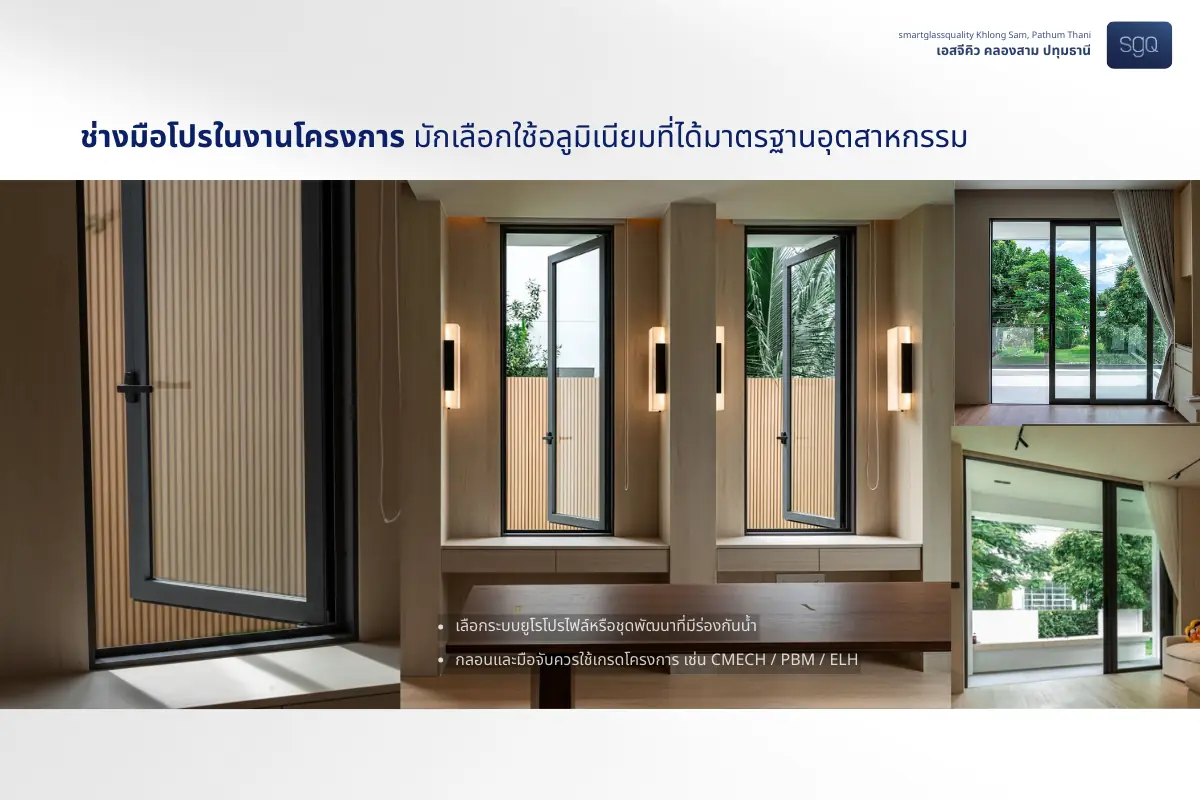
- Choose Euro Profile or Develop Set systems that include a water drainage system.
- Use bearing rollers or stainless-steel tracks for heavy-duty sliding doors.
- Locks and handles should be project-grade, such as CMECH, PBM, or ELH.
Additionally, do not forget to select aluminum door–window accessories suitable for project applications—such as bump stoppers, dust seals, and corner covers—to ensure the overall installation looks clean, complete, and professionally finished.
How to Inspect Work After Installation: Door and Window Handover Inspection Checklist
Before handover, QC teams typically inspect three main areas:
- Installation alignment — frames and panels must be level, straight, and free from distortion.
- Opening–closing and locking mechanisms — must operate smoothly, without noise or sticking.
- Water and air leakage — tested by spraying water or using a high-pressure fan.
If all three criteria are met, the installation is considered project-grade standard.
Checklist Before Handover (For Installers):
☑ Check the vertical and horizontal alignment of the frame.
☑ Ensure rollers and tracks operate smoothly without friction.
☑ Inspect silicone sealant to ensure it is smooth, continuous, and properly applied.
☑ Confirm that the glass panels do not wobble or vibrate.
☑ Test locks and handles to ensure full functionality.
🏗️ Looking for materials and accessories for project-based work? SGQ has everything you need.
Fuji Eurotech, SMS Schimmer, ORM, Thai Metal | Tempered / laminated glass
Bearing rollers, EPDM rubber seals, exterior-grade silicone, and complete accessories.
Tips from SGQ Khlong Sam that technicians should know for project-based work
- Always leave proper clearance space around the frame, especially in condominium projects where walls are rarely perfectly flat.
- Choose high-quality powder-coated or anodized aluminum to protect against scratches and long-term fading.
- Silicone sealant is extremely important! Using low-grade silicone can lead to yellow stains or water leakage within just a few months.
- Always test the door–window system before installing the actual glass, as it allows more accurate adjustment of alignment and opening–closing performance.
If you need guidance on selecting the right aluminum thickness for project doors and windows, or choosing accessories that match the specification, SGQ Klong Sam is happy to assist you—because we believe that “beautiful work starts with the right materials.”
Perfect Finishing with the Right System — Tips from Professional Installers
Ultimately, project-standard aluminum door and window installation isn’t defined only by how good it looks on handover day, but by its long-term strength and the customer’s satisfaction over years of use. Whether you choose a Euro Profile system or a Develop Set, selecting the right system for the project and installing it correctly from the beginning will result in a clean finish, solid structure, and premium appearance.
For contractors or builders looking for high-quality project materials—such as aluminum profiles, processed glass, and complete door–window hardware—visit SGQ Klong Sam (Smart Glass Quality). Our team understands real job-site conditions and is ready to provide professional advice.
📖 Related Articles
Standard Aluminum Thickness: Which Specification Should You Choose for Your Project?
Understand thickness specifications before ordering materials for project-based work.
Aluminum Door Parts and Accessories: What Should Technicians Know?
Choose the right grade of accessories for project-based work to reduce issues during inspection.
Techniques for Maintaining Aluminum Doors and Windows for Long-Lasting Use
After proper standard installation, continue regular maintenance to keep customers satisfied in the long term.
Techniques for Cutting Aluminum Smoothly Without Damaging the Profile or Leaving Sharp Edges
Good installation starts with proper cutting from the beginning.
Summary of Aluminum Door and Window Installation to Meet Project Standards
- Project-based work ≠ residential work — it requires shop drawings, QC approval, and testing for leakage, wind load, and repeated opening-closing cycles.
- 5 key steps — site inspection, frame installation, sash installation, silicone sealing, and testing before handover.
- 70% of problems come from incorrect frame alignment at the initial stage, so every point must be checked with a spirit level.
- Key materials — aluminum thickness ≥1.2 mm for sliding sashes / ≥1.6 mm for swing sashes, EPDM rubber seals, and exterior-grade silicone.
- Testing before handover — open and close each sash 10 times, and inspect the roller track, silicone sealant, lock, and glass alignment.
- Consultation for project-spec materials — SGQ Khlong Sam, call 081-885-2629 | LINE: @sgqklongsam
Frequently Asked Questions: Aluminum Door and Window Installation for Project Standards
1. How should aluminum doors and windows be installed to meet project standards?
It should follow 5 main steps: inspect the site and opening dimensions, align the frame using a spirit level to check vertical lines on all sides, install the sash so the track is not tilted, seal with exterior-grade silicone, and test each sash by opening and closing it 10 times before handover.
2. How do you align an aluminum frame properly for project-based work?
Use a spirit level or laser level to check vertical alignment on every side. Leave a free clearance of about 3–5 mm around the frame to allow for expansion. Fix the frame with countersunk screws spaced 30–40 cm apart at each poi
3. What should be included in an aluminum door and window handover inspection checklist?
The QC team usually checks 3 main points: the vertical alignment and plane of the frame (tolerance ±2 mm), the opening-closing and locking system (must operate smoothly without catching sounds), and water and air leakage (tested by spraying water or using a high-powered fan).
4. What thickness should be used for aluminum in project-based work?
The minimum thickness for project-based work is 1.2–1.6 mm. Sliding sashes should use no less than 1.2 mm, while swing sashes should use no less than 1.6 mm. For high-rise buildings or areas with strong wind, the specifications should be clearly stated in the drawings before ordering materials.
5. Why do sliding sashes in project-based work often become stiff after installation?
The main causes are tilted tracks, uneven rollers, or cement debris inside the track. The solution is to realign the track, replace the rollers with double-bearing rollers that can support more weight, and always clean the track before installing the sash.
About the Author
This article was written by the SGQ Khlong Sam team. A complete supplier of aluminum profiles, processed glass, and door and window accessories, with real experience in both project-based and residential work across Pathum Thani and Bangkok.
🏗️ Looking for project-spec materials and accessories? Consult SGQ today.
Aluminum profiles | Tempered / laminated glass | Bearing rollers | EPDM rubber seals | Exterior-grade silicone
Our team understands real site conditions and is ready to provide professional recommendations.
📍 19/60-61 Moo 7, Khlong Sam, Pathum Thani | Open Monday–Saturday, 08:00–17:30
For Aluminium Contractors & Installers
If you need aluminium profiles, quality glass, premium hardware, custom cutting & fabrication, installation tools, or on-site technical advice,
you can contact us at:
• Line : https://lin.ee/Wkn1Ong
• Tel : 081-885-2629
• Facebook : Smartglassquality
For Homeowners & Project Owners
If you are looking for aluminium door–window installation, glass works, sliding and swing systems, room partitions, or high-quality materials for home renovation
you can contact us at:
• Line : https://lin.ee/Wkn1Ong
• Tel : 099-392-1963 , 097-936-1449