News&Knowledge from SgQ
Aluminum Windows in Every Style: A 2026 Guide to Buying, Pricing, and Installation
There are 5 main types of aluminum windows: sliding, casement, awning, bi-fold, and fixed windows. The approximate market price ranges from THB 3,500–12,500 per square meter, depending on the window type and system selected. For general residential use, a 1.5 mm profile is recommended because it is more durable and helps reduce long-term water leakage issues. Most water leakage problems are caused by deteriorated sealant silicone, not the EPDM rubber seals.
✍️ Written by: SGQ Team (SmartGlassQuality Khlong Sam)
📅 Last updated: 7 April 2026
- How Many Types of Aluminum Windows Are There?
- What Is the Difference Between 1.2 mm and 1.5 mm Thickness?
- Standard Sizes for Aluminum Windows
- Aluminum Window Prices in 2026 by Type
- Aluminum Windows vs. uPVC: Which Is Better?
- How to Choose the Right Aluminum Windows for Your Home
- An 8-Point Checklist for Inspecting Window Installation Work
- Frequently Asked Questions (FAQ)
Aluminum windows are one of the most frequently asked-about building materials in the construction and home decoration industry because they come in many styles, various thicknesses, and price ranges from a few thousand to tens of thousands of baht. As a result, many people are confused about which type to choose, what thickness is appropriate, and how much budget is needed to get good value.
This article compiles insights from the experience of the SGQ technician team, who have completed aluminum window installation projects across Pathum Thani and Bangkok. We will walk you through a comparison of every type of aluminum window, along with a 2026 price table and an inspection checklist that professional installers actually use.
You will find answers to the most frequently asked questions, including the difference between 1.2 mm and 1.5 mm thickness, whether aluminum windows or uPVC windows are the better choice, and how to prevent long-term water leakage problems.
💬 Consult the SGQ technician team for free — no charges apply.
Not sure which type of window is right for your home? Let us know the installation opening size and the type of work required, and the SGQ technician team will provide recommendations and a free preliminary estimate.
📞 Call 081-885-2629 | 099-392-1963
💬 Line: @sgqklongsam
How Many Types of Aluminum Windows Are There?
Aluminum windows currently available on the market can be divided into 5 main types based on their opening and closing system. Each type has its own strengths and limitations. Choosing the right one for the space and intended use can significantly reduce future problems.
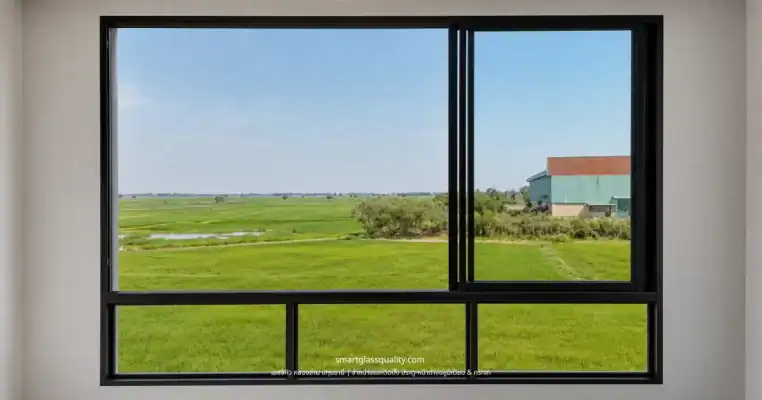
Sliding Window: Opens and closes sideways, saving space in front of the window
Sliding windows are the most popular type in Thai homes because they open and close by sliding the panels left and right. They do not require front clearance, making them ideal for rooms with furniture placed close to the wall, such as bedrooms, living rooms, or balcony areas.
- Best for: Bedrooms, living rooms, balconies
- Advantages: Space-saving, easy to install, most affordable option
ข้อดี: ประหยัดพื้นที่, ติดตั้งง่าย, ราคาถูกที่สุด - Limitation: Can only be opened up to half of the window area for ventilation
Casement Window: Opens outward, allows full-window ventilation
A casement window works like a door, with the sash swinging outward (or inward). Its main advantage is that it can open to 100% of the window opening, allowing better ventilation than a sliding window. It is ideal for bathrooms, kitchens, or areas that require high airflow.
- Best for: Bathrooms, kitchens, rooms that require good ventilation
- Advantages: Full-window ventilation, better rain protection than sliding windows
- Limitation: Requires front clearance for the sash to swing open
Awning Window: Opens upward, offers excellent rain protection
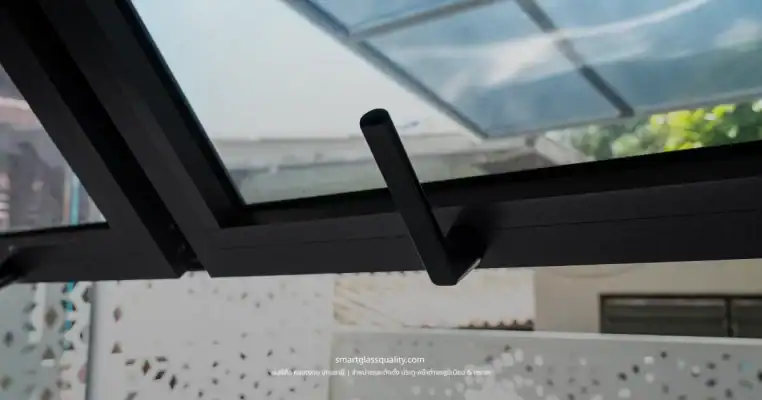
An awning window is a type of window that opens outward from the top, with hinges installed along the upper edge. When opened, the sash acts like a small built-in canopy, providing very good protection from light rain. It is commonly used in bathrooms or storage rooms where continuous ventilation is needed even during rainy weather.
- Best for: Bathrooms, storage rooms, areas that need ventilation during rainy weather
- Advantages: Allows airflow even during rain, as the sash acts like a canopy
- Limitation: The sash size is usually not very large, and the price is higher than sliding windows
Bi-fold Window: Foldable panels that maximize the opening space
A bi-fold window system consists of multiple panels that fold and stack together like an accordion. When fully opened, it can create an opening of nearly 100%, making it a popular choice for homes that want to seamlessly connect indoor spaces with a balcony or garden. It is often found in modern-style homes or cafés.
- Best for: Balconies, open spaces, modern-style homes
- Advantages: Maximizes the opening space and offers an attractive appearance
- Limitation: Much more expensive than sliding windows and requires maintenance of the hinge joints
Fixed Window: Non-operable, designed to maximize natural light and direct views
A fixed window, also known as a picture window, is a non-operable window that cannot be opened or closed. It is specifically designed to bring in natural light and showcase outside views. It is often combined with sliding or casement windows to enhance the overall appearance and is a more economical option for areas that do not require ventilation.
- Best for: High walls, auxiliary light openings, used together with sliding windows
- Advantages: Affordable, provides the tightest waterproof sealing, and has no moving parts that can wear out
- Limitation: Does not provide any ventilation at all
What Is the Difference Between 1.2 mm and 1.5 mm Thickness, and Which One Should You Choose?
The thickness of the aluminum profile is one of the most important factors affecting strength, service life, and price. However, many people overlook this point because the difference is barely noticeable from the outside.
In summary: 1.2 mm thickness is suitable for temporary projects or limited budgets, while 1.5 mm offers better long-term value for permanent installations.
Aluminum Profile Thickness Comparison: 1.2mm vs 1.5mm
| Feature | 1.2 mm | 1.5 mm ⭐ Recommended |
|---|---|---|
| Strength | Moderate | High — Better load resistance |
| Best For | Temporary structures / tight budgets | Homes / Condos / Offices |
| Material Cost | ~15–20% cheaper | Higher cost, better long-term value |
| Lifespan | 10–15 years | 15–25 years |
| Warping Risk | Higher (large panels) | Lower — holds shape reliably |
| Water Leakage Risk | Higher when frame warps | Lower — seals more tightly |
| Recommended For | Budget builds / temporary structures | ✅ All permanent installations |
📖 Read more about profile thickness: Aluminum Thickness for Door and Window Applications | Aluminum Thickness Standards
Standard Aluminum Window Size Table (for residential homes in Thailand)
Standard window sizes for homes in Thailand typically follow TIS standards and common opening dimensions used in construction. Choosing sizes that align with these standards helps reduce both production costs and lead time.
Standard Aluminum Window Sizes (Width × Height)
| Aluminum Windows (Width × Height cm.) | Popular Type | Common Applications |
|---|---|---|
| 60 × 110 | 2-panel sliding window | Bedroom, small bathroom |
| 90 × 110 | 2-panel sliding window | Bedroom, home office |
| 120 × 110 | 2–3 panel sliding window | Living room, guest room |
| 150 × 110 | 3-panel sliding window | Living room, balcony |
| 60 × 60 | Awning / Fixed window | Bathroom, high-level light openings |
| 90 × 150 | Casement / Bi-fold window | Balcony, glass doors |
💡 Note: The sizes above are general standard sizes. Custom sizes can also be made to order as needed. The stated dimensions refer to the overall window frame size, not the wall opening size. It is recommended to measure the wall opening first, then subtract 1–2 cm on each side to allow space for sealant application.
Aluminum Window Prices in 2026 by Type
Aluminum window prices depend on several factors, including the window type, profile thickness, size, glass type, and installation labor. The table below shows approximate market prices for 2026, compiled from data from businesses in the industry, for general residential use with 1.2 mm aluminum thickness, standard powder-coated color, and 6 mm float glass included.
Approximate Market Prices in 2026 (Including Standard Glass)
| Window Type | System | Price (THB/sq.m.) |
|---|---|---|
| 2-Panel Sliding Window | Standard Thai Sliding System | 3,500–5,000 |
| 2-Panel Sliding Window | Euro / Enhanced System | 5,500–6,800 |
| Casement Window | Swing System | 6,000–8,000 |
| Awning Window | Standard System | 4,500–7,000 per panel* |
| Bi-fold Window | Bi-fold System | 10,000–12,500 |
| Fixed Window | — | Approximately 15–20% lower than sliding windows |
📌 Note: The prices above are approximate market prices as of 2026, based on data from businesses in the industry. Actual prices may vary depending on size, glass type (tempered/laminated), profile thickness, and installation area. *Awning windows are usually priced per panel rather than per square meter because their sizes are typically not large.
📋 Request a Quote for Aluminum Windows
Provide the width × height dimensions and the type of work, and the SGQ team will prepare a preliminary estimate within 1 business day.
📞Call 081-885-2629 | 099-392-1963
💬 Line: @sgqklongsam
What Makes Aluminum Window Prices Vary from One Supplier to Another?
The price differences between suppliers usually come from four main factors, as follows:
-
Profile thickness: Suppliers using 1.2 mm profiles usually offer lower prices than those using 1.5 mm profiles, but the quality is different.
-
Glass type: Standard clear glass is less expensive, while tempered glass or heat-resistant glass costs around 30–50% more.
-
Profile brand: Profiles from standard brands certified by TIS are more expensive than non-standard profiles.
-
Labor and distance: Local installers often charge less, but their experience should also be considered.
How to Estimate the Initial Cost of Aluminum Door and Window Installation
Aluminum door and window pricing is not fixed per panel. Instead, it is primarily estimated based on the actual dimensions of the job, measured by width × height to calculate the preliminary area. The assessment also takes into account the panel type, aluminum series, color, glass type, and selected accessories.
To get a preliminary quotation that is as close as possible to the actual on-site price, it is recommended to prepare the following information before making an inquiry:
-
Width × height of the installation opening
-
Type of work required, such as sliding door / swing door / sliding window / casement window
-
Preliminary photos of the site
-
Province or installation area
-
Required specifications, such as aluminum color, glass type, or special accessories
Once you send in the details, the SGQ team will help prepare a preliminary estimate tailored specifically to your site conditions and budget. You can contact us at 081-885-2629 or add us on Line: @sgqklongsam
Aluminum Windows vs. uPVC: Which Is Better?
This is a very common question among people who are building or renovating a home. The short answer is: if your budget is limited and you need a standard solution, choose aluminum. But if you want better sound insulation or heat reduction, uPVC offers better long-term value.
Aluminum vs UPVC Windows: Full Comparison
| Comparison | Aluminum | UPVC |
|---|---|---|
| Price | More affordable | 20–40% more expensive |
| Weight | Lighter | Heavier |
| Sound Insulation | Moderate | Better |
| Heat Reduction | Moderate | Better |
| UV & Rust Resistance | Good (requires Anodizing) | Excellent — rust-free |
| Maintenance | Easy — wipe clean | Very easy — no repainting needed |
| Design Variety | Wide — many color options | Available but more limited |
| Lifespan | 15–25 years | 20–30 years |
| Best For | ✅ General use / budget projects | ✅ High noise & heat reduction needs |
How to Choose the Right Aluminum Windows for Your Home
To choose aluminum windows that best meet your needs in terms of functionality, budget, and durability, you should consider the following in order:
- Define the function: Do you need ventilation or only natural light? → This helps determine the window type.
- Check the space: Is there enough front clearance for a casement window, or do you need a sliding window?
- Choose the thickness: For permanent installations, always choose 1.5 mm.
- Choose the right glass: For rooms exposed to the western sun, heat-resistant glass is recommended
- Check TIS certification: Ask to see the profile standard certification documents before placing an order.
What Type of Glass Should You Choose for Aluminum Windows?
The types of glass commonly used with aluminum windows can be categorized by application as follows:
- Standard clear glass: The most affordable option, suitable for rooms that are not exposed to direct sunlight.
- Tempered glass: 5 times stronger, suitable for doors and ground-floor windows.
- Solar control glass: Reduces heat by 30–60%, suitable for rooms exposed to strong sunlight.
- Double-glazed glass: Provides the best sound insulation and heat reduction, but comes at a higher price.
Why Is Sealant Silicone More Important Than You Think?
From the SGQ technician team’s experience, most water leakage problems in aluminum windows are not caused by the EPDM rubber seals or the aluminum frame itself, but by the sealant silicone around the frame deteriorating over time and due to material expansion.
⚠️ Real-world insight from SGQ Khlong Sam
Most water leakage issues in aluminum windows are caused by cracked or detached sealant silicone around the frame, not by the EPDM rubber seals as many people assume.
Recommendation: Choose neutral cure silicone for aluminum applications and inspect or repair it every 5–7 years.
8-Point Checklist After Installing Aluminum Windows
After the installer finishes the work, do not accept the job immediately. Always inspect the following 8 items first to prevent problems that may arise later.
8-Point Inspection Checklist After Aluminum Window Installation
| # | Inspection Item | Status |
|---|---|---|
| 1 | Check seals and silicone around the entire frame — must be fully flush with no gaps or cracks | ☐ |
| 2 | Test opening and closing — sliding panels must glide smoothly with no sticking or looseness | ☐ |
| 3 | Check level and plumb — frame must be perfectly square with no warping or twisting | ☐ |
| 4 | Water test — pour water around the frame and check for any leaks or seepage | ☐ |
| 5 | Inspect aluminum frame and glass for scratches — surface should be completely mark-free | ☐ |
| 6 | Test locks and handles — must lock securely with no looseness or stiffness | ☐ |
| 7 | Tap glass gently and listen — inspect for cracks, chips, or air bubbles in the pane | ☐ |
| 8 | Collect the installation warranty from the technician and keep a copy of the quotation for reference | ☐ |
💡 Tip: Take photos of every window after the job is accepted and keep them as evidence for any future warranty claims. Test for water resistance by using a hose to spray water around the frame for at least 30 seconds per spot.
How to Choose Aluminum Windows for the Best Value
Before making a purchase decision, make sure to check all of the following:
- There are 5 types of aluminum windows: sliding, casement, awning, bi-fold, and fixed. Each type is suited to different spaces.
- For permanent installations, always choose 1.5 mm thickness. It offers a service life that is more than 10 years longer and provides better long-term value.
- Most water leakage problems come from sealant silicone, not the EPDM rubber seals. Inspect and repair it every 5–7 years.
- Market prices range from THB 3,500–12,500 per sq.m., depending on the window type and system.
- Before accepting the completed job, always inspect it using the 8-point checklist.
Consult the SGQ technician team for free — no charges apply.
Not sure which option is best for your home? The SGQ technician team is ready to provide advice and a preliminary estimate at no cost. Simply send us the installation opening dimensions and the type of work, and we can immediately help you choose the most suitable system.
📞 Call: 081-885-2629 | 099-392-1963
✍️ Written by: SGQ Smart Glass Quality Technician Team
📅 Published: 7 April 2026 |
🔄 Last updated: เมษายน 2569
Frequently Asked Questions — Aluminum Windows
1. What is the difference between 1.2 mm and 1.5 mm thickness, and which one should you choose?
A 1.5 mm profile is stronger, more durable, and helps reduce the risk of water leakage in the long term. Although it costs around 15–20% more, its service life can be up to 10 years longer. For all types of permanent installations, 1.5 mm is always recommended. As for 1.2 mm, it is suitable only for temporary projects or limited budgets.
2. For residential homes, which is better: aluminum windows or uPVC?
It depends on your needs. If you want a general-purpose solution at an affordable price, aluminum is a good choice.
However, if you want better sound insulation or greater heat reduction,
uPVC offers better long-term value, even though the initial price is 20–40% higher.
3. How is an awning aluminum window different from a casement window?
A casement window opens sideways like a door. An awning window, on the other hand, opens outward from the top, and the sash acts like a small canopy. As a result, it provides better protection from light rain and is ideal for bathrooms or areas that need ventilation during rainy weather.
4. What Are the Standard Window Sizes for Homes in Thailand?
The most commonly used sizes are 90 × 110 cm and 120 × 110 cm for sliding windows. These standard sizes match the common wall opening dimensions used in Thai housing developments. They help reduce the cost of custom fabrication. It is always recommended to measure the actual wall opening before placing an order.
5. How Should You Repair a Leaking Aluminum Window?
The first step is to inspect for cracks in the sealant silicone around all four sides of the frame. Because that is the main cause in most cases. If cracks are found, remove all of the old silicone completely and reseal it with neutral cure silicone designed for aluminum applications. If the leakage continues, inspect the drainage track and EPDM rubber seals.
6. How Much Do Aluminum Windows with Glass Cost in 2026?
The approximate market price for standard-system sliding windows with glass included is THB 3,500–5,000 per sq.m. For Euro systems, the price is around THB 5,500–6,800 per sq.m. Bi-fold windows are the most expensive, at around THB 10,000–12,500 per sq.m. Prices vary depending on size, glass type, and installation area. It is recommended to request a quotation directly from the installer.
7. Do Aluminum Windows Provide Good Rain Protection, and Is Anything Else Needed?
Aluminum windows can provide good rain protection if they are installed properly and sealed correctly with silicone. Awning windows provide the best rain protection, followed by casement windows. Sliding windows should have a drainage track and additional rain protection accessories. The important thing is to inspect the sealant silicone every 5–7 years and clean the drainage track every 6 months.
Order and Install Aluminum Windows with SGQ Khlong Sam
Choose the style, choose the specifications, get precise fabrication, and professional installation by our technician team — all in one place.
📍 19/60-61 Moo 7, Khlong Sam, Pathum Thani | Open Monday – Saturday, 8:00 AM – 5:30 PM
For Aluminium Contractors & Installers
If you need aluminium profiles, quality glass, premium hardware, custom cutting & fabrication, installation tools, or on-site technical advice,
you can contact us at:
• Line : https://lin.ee/Wkn1Ong
• Tel : 081-885-2629
• Facebook : Smartglassquality
For Homeowners & Project Owners
If you are looking for aluminium door–window installation, glass works, sliding and swing systems, room partitions, or high-quality materials for home renovation
you can contact us at:
• Line : https://lin.ee/Wkn1Ong
• Tel : 099-392-1963 , 097-936-1449