News&Knowledge from SgQ
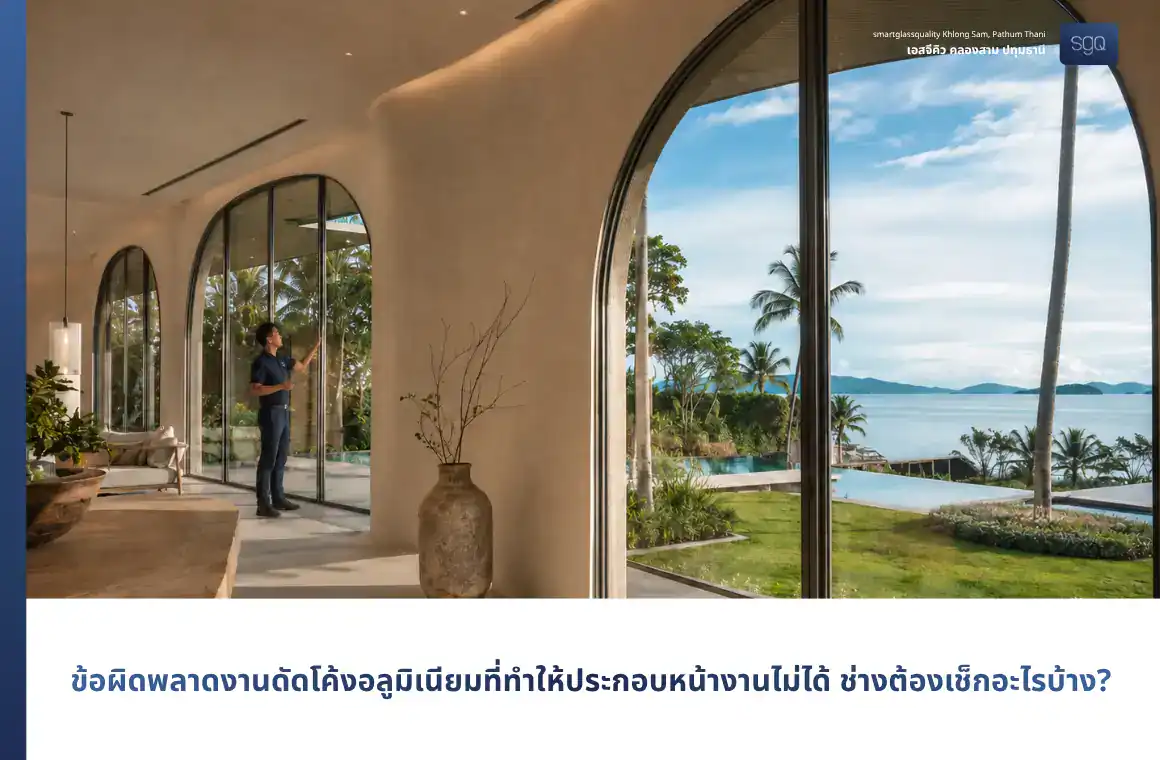
Aluminum Bending Errors That Prevent On-Site Assembly: What Should Technicians Check?
Aluminum bending problems that prevent on-site assembly usually result from seven main issues: incorrect curve radius measurements, incomplete information sent to the bending shop, unsuitable aluminum profiles, uneven curves, difficulty fitting the glass into the groove, seals that do not sit tightly around the curve, and failure to inspect the workpiece before installation. Technicians should always check the drawings, dimensions, curve starting points, profiles, glass, frame grooves, and joints before transporting the components to the installation site.
✍️ Written by: SGQ Team (SmartGlassQuality Khlong Sam)
📅 Last Updated: July 20, 2026
- Why Is Curved Aluminum Work More Prone to Errors Than Straight Work?
- Error 1 — Incorrect Curve Radius Measurement
- Error 2 — Incomplete Information Sent to the Bending Shop
- Error 3 — Choosing an Unsuitable Aluminum Profile
- Error 4 — Uneven or Asymmetrical Curves
- Error 5 — Difficulty Fitting the Glass into the Groove
- Error 6 — Poorly Fitted Seals and Risk of Water Leakage
- Error 7 — Failure to Inspect the Workpiece Before Installation
- Summary Table of Problems and Preventive Measures
- Checklist Before Sending Aluminum Profiles to the Bending Shop
- Summary: What Should Technicians Check Before Aluminum Bending?
- Frequently Asked Questions (FAQ)
Curved aluminum work requires greater precision than straight aluminum work because the frame, glass, radius, curve starting points, and all joints must align correctly. Incorrect measurements, improper bending, or unsuitable profile selection can prevent on-site assembly, cause water leakage, or lead to repeated rework.
For technicians and contractors, common problems are not limited to curves that look uneven. They also include distorted curved frames, deformed glass grooves, difficulty fitting the glass into the groove, gaps between straight and curved sections, and water leakage at high-risk points after installation.
This article covers common errors to avoid, preventive measures, and a checklist to review before sending aluminum profiles to the bending shop. It helps reduce the risk of wasting frames, glass, time, and on-site costs.
💬 Not sure whether your curved-work drawings contain all the required information?
Send photos of the site, the opening dimensions, and the curve design to the SGQ team for an initial review.
Line: @sgqklongsam | 📞 081-885-2629
Why Is Curved Aluminum Work More Prone to Errors Than Straight Work?
Straight-frame work often allows for minor on-site adjustments, such as leaving a small allowance, realigning the panels, or improving the joints. With curved work, however, an incorrect radius from the production stage is usually difficult to fix on-site and may affect the frame, glass, and installation schedule.
- Curved work involves a radius and specific curve shape, not just width × height measurements like straight-frame work.
- The aluminum cross-section may become deformed if the profile is unsuitable or the bending process is incorrect.
- The glass must be cut to match the frame’s shape and radius. If the frame is distorted, the glass is often difficult to fit into the groove.
- The joints between curved and straight sections must fit tightly because they are highly visible and prone to water leakage.
- If the actual opening does not match the drawing, installation becomes more difficult and the frame may appear asymmetrical.
💡 Curved aluminum work should be thoroughly checked before production, as errors involving the radius or frame cross-section are much more difficult to correct on-site than errors in straight-frame work.
Error 1: Incorrect Curve Radius Measurement
The curve radius is the key to curved aluminum work. If it is measured or calculated incorrectly from the beginning, the bent frame may not fit the actual opening and can also affect glass cutting, panel alignment, and the overall finish of the joints.
Common Signs
- The frame does not fit the opening properly and must be forced into place, or gaps appear in some areas.
- The curve does not match the drawing or reference approved by the customer.
- The left and right sides are asymmetrical, making the frame appear misaligned when viewed from the front of the house.
- The custom-cut glass does not fit the frame groove, resulting in additional correction time.
Preventive Measures
- Measure the width, overall height, and curve starting point completely. Do not provide only the width × height dimensions.
- Provide a CAD drawing, hand-drawn plan, or site photos so the bending shop can clearly understand the actual proportions.
- Check the opening after the final plastering work is completed before placing the production order, as the dimensions may change after wall construction.
- Do not estimate the radius from photos alone, especially when the glass must be custom-made to match the curve.
→ Read More: How to Measure Curved Aluminum Accurately for a Precise Price Estimate
Error 2: Incomplete Information Sent to the Bending Shop
Curved aluminum work requires several pieces of information to be considered together. If the technician provides incomplete details, the shop may be unable to estimate the price accurately or may misunderstand the required design. This can lead to repeated follow-up questions and delays during the drafting and estimation process.
Information Commonly Left Out
- The opening system is not specified, such as a fixed panel, casement window, sliding window, or door.
- The curve starting point is not specified, making it difficult for the shop to determine the intended curve shape.
- The frame color is not specified, which may result in inaccurate cost and finishing-time estimates.
- The glass type and thickness are not specified.
- The required number of pieces or sets is not specified.
- The shop is not informed whether the project is a new build, a renovation, or an installation with an existing frame.
Possible Consequences
- The estimated price may differ from the actual cost of the work.
- The finished product may not match the required design or the actual opening system.
- The drawing may need to be revised several times before production can begin.
- On-site work may be delayed because key details that should have been confirmed from the beginning are still unclear.
Error 3: Choosing an Aluminum Profile That Is Unsuitable for Bending
Not all aluminum profiles are equally suitable for curved applications. Some have complex cross-sections, some are too thin, and others have glass grooves in positions that are prone to deformation after bending. Choosing the wrong profile from the beginning may cause the frame to twist, lose its shape, or make glass installation difficult.
- Profiles that are too thin may deform easily under bending force.
- Some complex cross-sections are more difficult to bend and control than simpler profiles.
- The glass groove may become distorted after bending, preventing the glass from fitting fully into place or causing an uneven seal line.
- The surface finish may be damaged if the bending and coating processes are carried out in the wrong sequence or with unsuitable methods.
⚠️ SGQ’s View: Before sending the aluminum profile for bending, check whether it is suitable for curved applications. Consider the cross-section, thickness, glass groove system, and load-bearing points. Do not choose a profile based solely on its color or appearance.
Error 4: Uneven Curves or Asymmetrical Sides
A well-made curve should appear smooth, continuous, and symmetrical, without any waviness. This is especially important for installations at the front of a house or on highly visible walls. Even if the frame can still be installed, an uneven curve can make the work look unfinished and affect the overall appearance of the house.
Common Signs
- The curve appears wavy and does not flow continuously from one end to the other.
- The two ends of the curve are uneven or finish at different levels.
- The left and right sides are asymmetrical when viewed from the front.
- The frame appears misaligned when installed in an opening that is a prominent feature of the house.
Preventive Measures
- Use a bending shop with experience in curved aluminum work and a clear understanding of each profile’s limitations.
- Provide a clear drawing that specifies the radius, curve starting point, and curve shape.
- Inspect the workpiece before installation, checking both the curve alignment and the end positions of the curve.
- Check the continuity of the curve visually and by actual measurement, rather than relying on photos alone.
Error 5: Difficulty Fitting the Glass into the Groove or Frame
Curved glass and frames must match more precisely than straight-frame systems because the glass must be cut to follow the frame’s radius and shape. If the glass groove becomes deformed after bending, or if the glass is cut from a drawing that does not match the actual frame, assembly will immediately become difficult.
Possible Causes
- The glass groove becomes twisted or narrower in some sections after the frame is bent.
- The frame and glass radii do not match, preventing the glass from sitting evenly in the groove.
- The glass clearance is unsuitable for the frame system and glazing gaskets.
- The glass is too thick for the frame groove, or the specifications were not checked before cutting.
Preventive Measures
- Specify the glass type and thickness from the beginning, before preparing the frame production drawings.
- Check the profile’s glass groove specifications to confirm that they can support the required glass.
- Measure and order the glass based on a clear drawing rather than approximate dimensions.
- Inspect the curved frame before ordering the actual glass, especially for work that requires custom-shaped glass.
Error 6: Poorly Fitted Seals Around the Curve and Risk of Water Leakage
Water leakage around curved windows is usually not caused by a single issue. It often results from several factors combined, such as the frame not sitting flush against the wall, an opening that is not square, discontinuous silicone sealant lines, or poorly finished joints between curved and straight sections. This is especially common in exterior installations exposed to wind-driven rain.
High-Risk Areas
- The joints between the curved and straight sections of the frame
- The lower corners of the frame where water tends to collect
- Exterior silicone sealant lines exposed directly to sunlight and rain
- Areas where the frame does not sit flush against the wall or where the gaps are uneven
- Gaps caused by walls that are not square, resulting in uneven sealant thickness
Preventive Measures
- Check that the frame fits properly before applying silicone. Silicone should not be used to fill large gaps.
- Use exterior-grade silicone suitable for aluminum and glass applications.
- Do not apply silicone over surfaces with dust, moisture, or cement residue.
- Perform a water test after installation in high-risk areas, especially at the lower corners and curved joints.
→ Read More About Water Leakage and Silicone Sealants: : Exterior Waterproof Silicone Identify the Source of the Leak Before Sealing It with the Correct Product
Error 7: Failing to Inspect the Workpiece Before Bringing It to the Installation Site
Curved aluminum work should always be inspected before being transported to the installation site. If the frame is found to be twisted, the glass groove is deformed, or the dimensions do not match the drawing after arriving on-site, corrections will take more time and may also affect the schedules of other installation teams.
☑️ Pre-Installation Checklist
Summary Table of Curved Aluminum Work Problems and Preventive Measures
What should installers check before sending materials to a bending shop?
Before sending information to the shop for a price estimate or production order, technicians should thoroughly check the drawings, actual site conditions, opening system, aluminum profile, and glass specifications. This helps reduce follow-up questions and lowers the risk of production errors.
📋 Checklist Before Sending Curved Aluminum Work to the Bending Shop
💡 SGQ Khlong Sam can provide a preliminary assessment based on site photos and opening dimensions, even if a CAD drawing is not yet available.
Aluminum bending problems can be prevented before production begins.
Most curved aluminum work problems can be prevented during the measurement, drawing preparation, and profile selection stages. If the information is incomplete from the beginning, the finished work may have an incorrect radius, a twisted frame, poorly fitting glass, an uneven curve, or water leakage after installation.
The best way to reduce risk is to gather all required information before sending the work to the bending shop, check the profile before bending, clearly specify the glass type and opening system, and inspect every workpiece before transporting it to the installation site.
Need Help Reviewing a Curved Aluminum Work Drawing? Consult SGQ
Technicians and contractors working on curved doors, curved windows, or curved fixed-glass panels can send drawings, site photos, and dimensions to the SGQ team for a preliminary assessment. Our team can help review the information required before production, including the curve shape, opening system, profile, glass, and potential on-site risk areas.
📐 Not Sure Whether Your Selected Profile Can Be Bent? Let SGQ Check It for You
Send us the profile name, a cross-section image, or site photos.
The SGQ team will help check whether the profile is suitable for curved applications before production.
📖 Related Articles
Overview of Curved Aluminum Door and Window Work
View Examples of Arched Designs and Custom Styles Available from SGQ
How to Measure Curved Aluminum Accurately for a Precise Price Estimate
A Detailed Guide to Measuring the Radius, Curve Starting Point, and Information Required by the Bending Shop
How Much Do Curved Windows Cost? Factors That Make Curved Designs More or Less Expensive
Learn More About the Factors That Affect Arched Window Prices
Exterior waterproof silicone: find the root cause of the leak first, then seal it with the right type.
Read More About Water Leakage and Choosing the Right Silicone Sealant
Summary: What Should Technicians Check Before Curved Aluminum Work?
- Inspect the frame before ordering the glass — if a curved frame is distorted, the entire custom-cut glass panel may need to be remade.
- Check the profile before bending — not every aluminum profile is suitable for curved applications. Review the cross-section, thickness, and glass groove.
- Provide all eight required details — dimensions, curve starting point, radius, opening system, frame color, glass specifications, quantity, and site photos.
- Always take final measurements after plastering — dimensions before and after plastering may differ by several centimeters.
- Perform water testing at high-risk points — including curved-to-straight joints, the lower frame corners, and exterior silicone sealant lines before handing over the work.
- If the profile cannot be bent, offer alternative solutions: change the profile, adjust the radius, or combine straight panels with a curved fixed-glass section.
Frequently Asked Questions: Aluminum Bending Problems
1. Can a Deformed Curved Aluminum Frame Be Repaired, or Should It Be Remade?
It depends on the location of the deformation and the extent of the damage. Minor marks or small assembly issues may be repairable. However, if the radius is incorrect, the frame is twisted, or the glass groove is deformed to the point that the glass cannot be installed, the entire piece should usually be reassessed. Forcing the frame back into shape may damage the surface finish, collapse the cross-section, or prevent the seals from fitting tightly over time.
2. Can a Slightly Twisted Curved Frame Still Be Installed?
Do not install it immediately. First, compare it with the drawing and the actual opening. If the frame is twisted to the point that the glass groove is misaligned, the seal does not fit tightly, or the joints do not close properly, have the shop inspect and correct it before taking it to the site. Once it has been installed and silicone has been applied, fixing the problem will be much more difficult.
3. Should Glass for Curved Work Be Ordered Before or After Inspecting the Frame?
For work that requires custom-cut curved glass, always inspect the curved frame before placing the final glass order. This is especially important when there is no clear CAD drawing. If the finished frame differs from the drawing, glass ordered in advance may not fit the frame groove and the entire panel may need to be recut.
4. If the plastered opening is uneven, should the opening be corrected first or should extra clearance be allowed for the frame?
If the opening is significantly slanted or the wall is clearly out of square, the opening should be assessed and corrected before production. Curved work requires greater symmetry than straight-frame work. Allowing too much clearance around the frame may result in uneven sealant thickness and increase the risk of long-term water leakage.
5. Can Water Leakage in an Installed Curved Window Be Repaired Without Removing the Frame?
It depends on the cause. If the leak is caused by cracked silicone sealant or poor adhesion, the old sealant can be removed and reapplied without removing the frame. However, if the leak is caused by the frame not sitting flush against the wall, poorly fitted joints between curved sections, or an opening that is not square, applying more silicone may provide only a temporary solution. The frame may need to be removed and adjusted for a permanent repair.
6. If the selected profile cannot be bent, how should the design be adjusted?
The profile’s limitations should first be clearly explained to the customer, followed by suitable alternatives. These may include switching to a profile that is more suitable for bending, increasing the curve radius, or combining straight panels with a curved fixed-glass section. These options can reduce the risk of frame deformation and provide better cost control.
About the Author
Written by the SGQ Khlong Sam technical team, a supplier and installer of doors and windows serving Pathum Thani, Bangkok, and nearby provinces. The information in this article is based on hands-on experience in reviewing designs, selecting profiles, and inspecting work before installation.
For Aluminium Contractors & Installers
If you need aluminium profiles, quality glass, premium hardware, custom cutting & fabrication, installation tools, or on-site technical advice,
you can contact us at:
• Line : https://lin.ee/Wkn1Ong
• Tel : 081-885-2629
• Facebook : Smartglassquality
For Homeowners & Project Owners
If you are looking for aluminium door–window installation, glass works, sliding and swing systems, room partitions, or high-quality materials for home renovation
you can contact us at:
• Line : https://lin.ee/Wkn1Ong
• Tel : 099-392-1963 , 097-936-1449